 US
US



One in four professional services projects runs late. SPI Research reports on-time delivery at 73.8%. When projects run behind schedule, clients start to lose confidence long before renewal is even discussed.
If you raise retention from 80% to 90%, a £3m firm needs £600,000 in new business for 10% growth instead of £900,000 That’s three fewer clients to find, pitch, price, and onboard.
68% of agencies regularly run over budget, and 57% lack real-time budget alerts. In many cases, the client spots the overrun before the agency does.
Retention isn’t always the top priority. If one client makes up a third or more of your revenue, keep pitching for new business. The real risk is relying too much on a single account, not the strength of the relationship.
Most firms assign sales a dedicated owner, set targets, and hold weekly reviews. Retention, by contrast, is often left to chance. It improves only when delivery, budget, and client data are tracked in one place and reviewed regularly.
Most professional service firms are wired to chase new business. It feels like the only way to grow. But the truth is, retaining the clients you already have is almost always the smarter, more profitable move.
Client acquisition is expensive - marketing, sales, onboarding, and time add up fast. Retention, on the other hand, is lean, scalable, and built on relationships you've already earned.
This guide will walk through why client retention deserves a front-row seat in your growth strategy and how tools like Magnetic can help you put it into practice.
Bringing on a new client means investing hours before you even sign a contract. Qualifying leads, scoping projects, preparing for pitches, refining proposals- none of it is billable. Lose the pitch, and that time is simply gone. Win, and you still face onboarding and groundwork before the real work begins.
Few firms count these hours as a real cost, since there's no invoice to flag them. Instead, the impact appears when senior staff are tied up and unavailable for paying clients. As a result, the hidden cost of new business is easy to miss, and you overlook retentions value.
You'll often head that landing a new client costs 5 to 25 times more than keeping on. That stat comes from a Harvard Business Review piece, but it isn't specific to professional services and doesn't cite. aclear source. Take it as a rough guide, not a rule. To find your own number, add up the hours you spent on proposals, pitches and discovery last year, multiply by your average hourly cost, and divide by the number of new clients won. If your time tracking leaves our non-billable business development, fix that first; otherwise your numbers will look better than they really are.
Smaller firms feel this the most. When a 40-person agency loses two pitches in a row, those hours come out of the same people who deliver for existing clients and those clients notice.
A returning client doesn't need you to spent on acquisition. They're already familiar with your teams ways of working, so onboarding is faster and briefs are easier. Existing clients are also your most reliable source of referrals and the simplest path to more work, because you've already earned the trust and new prospects need time to build.
The most quoted claim here is that a 5% increase in retention can boost profits by 25% to 95%. Frederick Reichheld and Phil Schefter made this claim in a 2000 article, focused on e-commerce, not on firms selling expertise by the hour. The idea has circulated for decades, often simplified or misapplied. Still, the mechanism holds: a retained client cuts acquisition costs and tends to make delivery smoother - both of which improve your margins. The clearest way to see the value of retention is to look at how much new business you need each year , just to replace the clients you lose.
This is a worked calculation with stated assumptions, not a case study. Take a firm with 30 clients paying an average of £100,000 a year, so £3 million in annual revenue. Assume departures are spread evenly across clients, ignore any growth from existing accounts, and set a 10% growth target.
Raising retention by ten points lowers the new business target by £300,000. Thats three fewer clients you need to win, pitch, and onboard, recucing the selling effort by a third compared to a firm with 80% retention. And if your existing accounts grow, the benefit only increases.
Clients don't usually decide to leave at renewal. The decision happens over months, shaped by small moments: a missed deadline, a late budget conversation, a handover where the new project manager hadn't read the brief. Renewal is just when you hear about it.
The benchmarks tell a similar story. SPI Researches' 2025 data published by Deltek, shows on-time project delivery at 73,.8%, nearly unchanged from the previous year. That means that about one in four projects run late. Project overruns are at 10.7% , which SPI highlights as a major factor in client trust. Meanwhile, the share of clients willing to serve as references dropped from 70.1% to 68.2%.
Our own data shows most agencies lack an early warning system. In Magnetic's Agency Benchmarking Survey of 104 agencies, 68% said they regularly ran over budget, and 57% said they had no real time budget alerts. Another 59% pointed to waiting for client feedback as the biggest bottleneck. When you add those up, you see the pattern behind most lost accounts: the budget slips, no-one catches it in time, and both you and the client discover the problem together.
When you look at the SPI numbers, it's clear: many firms can win work, but delivering well is where they often stumble and clients notice. The real takeaway is that retention is build day to day, not through litalty schemes. Staying on top of budgets, keeping project handovers tight and being upfront with clients when a problem comes up, does more to keep business than any quarterly gift basket.
Profit and retention often hinge on the same decisions and over-servicing is a classic pitfall. It's tempting to put in extra hours to keep a client happy, but those freebees eat into your margin and set a standard that's tough to undo. If you want to know how much work your team gives away, the Magnetic overservicing calculator translated unbilled time into lost revenue. Keeping a client at a loss isn't a win - it's a subsidy. The Magnetic profitability calculator can show you which accounts actually add value.
Putting retention first, isn't a hard-and-fast rule; it depends on what's really happening in your firm. The table below matches common warning signs to the actions that make sense in each case.
Two of these cases challenge the idea that retention should always come first. If one client accounts for a big share of your revenue, you need to keep pitching new business. Even a happy client can leave, and relying on a single account is risky. Similarly, if your repeat clients aren't profitable, you're facing a pricing problem that retention alone cannot fix, and more of those clients could make it worse.
Utilisation deserves a special mention. SPI research found billable utilisation fell to 66.4% in 2025, the lowest in their survey's history. If your team has spare capacity and not enough work in the pipeline, focusing on retention alone won't close that gap.
Retention often gets sidelined, even though it matters just as much as new business.
Winning new clients is easy to celebrate - a signed contract stands out. But when a client simply continues, it often goes unnoticed. Most incentives reflect this: sales targets focus on new revenue, and bonuses rarely depend on retaining existing clients. If a client seems satisfied and never complains, it's easy to mistake that for loyalty, even if it isn't.
Ownership is another common gap. Ask who is in charge of a client after the deal closes, and the answer is often "everyone". which usually means no one is truly accountable Sometimes the account director steps in, but often, responsibility gets passed around or overlooked. Without a dedicated owner, clear metric or regular review, retention doesn't get the attention it needs.
You don't need a formal programme, just a few habits you can stick to. Begin by finding the numbers firms don't r track or can't easily find.
Track metrics most firms overlook
Retention rate (for retainer clients) = clients at the end of the period, minus new clients won in that period, divided by clients at the start. Repeat rate (for project work) = clients who commissioned more work within 12 or 24 months, divided by clients whose projects finished in that window.
Track average client tenure and revenue per client alongside them, and add Net Promoter Score if you survey clients. Combine these with reporting that breaks profitability down by client so you can see who stays, who leaves and what each account is worth.
Assign a single person to each important client, with goals that cover both renewals and growth - not just new business. Check the list every month. When there's no clear owner, it's easy for clients to slip away unnoticed.
Send a short review after each project. Hold a quarterly check-in with your biggest clients and ask what to change. The value lies in visible follow-through. A client who sees their comment turn into a changed process is far more likely to stay than one who fills our a survey and hears nothing. A problem handled well often leaves the relationship stronger than before.
Trust starts from day one. A good onboarding sets the tone for the relationship and lays the foundation for how you'll work together. As the project runs, keep a close eye on scope and budget. Most accounts turn unprofitable when work expands beyond what was agreed - usually spotted in your time and date before the client sees it. Investing in project management that tracks time, budgets, and milestones in one place, means you can flag issues for your client long before they become a problem.
Client history often lives across inboxes, spreadsheets, and peoples memories. When someones leaves, all that context can disappear. A good CRM, brings every interaction, detail and preference together, so anyone on the team can pick up where the last person left off and spot when a client goes quiet.
Prioritising retention doesn't mean you stop filling your pipeline. In fact, your happiest clients, are often your best source of new business.
Referrals come first. Clients who trust you will sometimes introduce you to their peers, but almost never unprompted. Ask for a referral when the timing is right - after a successful project or positive review and make it easy for them to say yes.
Next is expansion with a caveat: Only suggest extra services when they meet a need the client has already voiced. Pushing something unrelated comes across as a sales tactic and can cost you trust.
Case studies come next. When a client is happy to be quoted, their words carry far more weight than any sales pitch, and future prospects get to see the real proof. Partnerships with complementary firms also help, putting you in front of clients who already trust the person making the introduction.
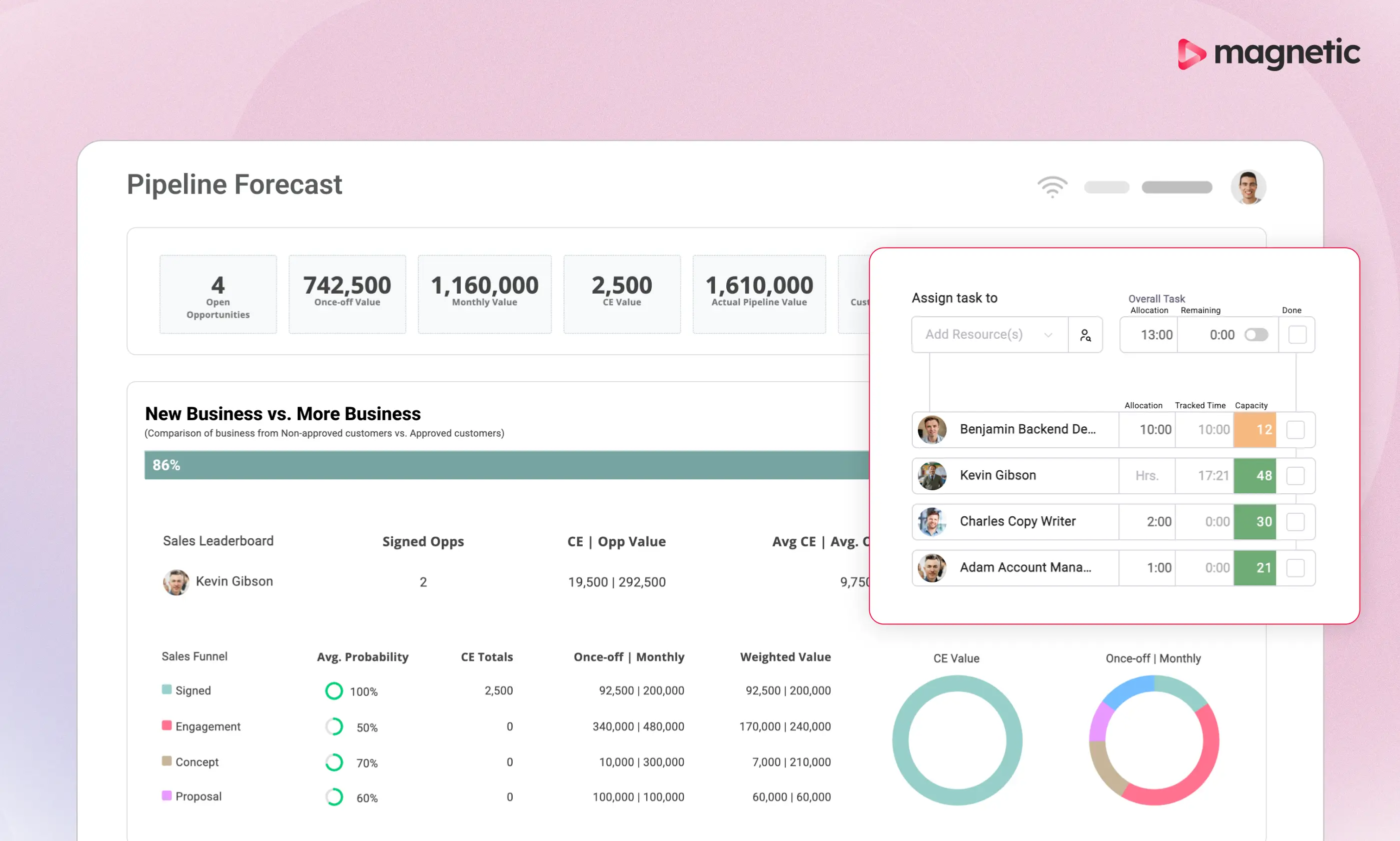
Magnetic is a professional services automation platform that connected the client relationship with the work happening behind it. Sales, delivery, resourcing and financial data are kept in one system, giving account teams a clear view of what was promised, how each project is progressing and wether the relationship remains profitable.
This gives teams the information they need to address delivery and commercial concerns before they damage client confidence. For a closer look on why this matters, read our guide to real-time profitability dashboards.
Pick your ten largest clients, For each one, note the part year's revenue, the person responsible for the account, the last time you asked for feedback, and whether their last two projects finished on time and on budget, Any gaps highlight where retention might be at risk can spot them in about an hour.
In most cases, the problem isn't the client relationship itself. It's that nobody can answer a budget question without digging through four different systems. If that sounds familiar, try a free 14-day trial of Magnetic and see how much easier it is to get these answers in one place
Start a free trial and see Magnetic with your own projects. No credit card required.
.svg)
Retaining clients is often more cost-effective than acquiring new ones. High client retention leads to increased profitability through repeat business, opportunities for upselling, referrals, and a higher lifetime customer value. Retention also supports stable revenue, reduces acquisition costs, and improves efficiency, making it a more sustainable growth strategy.
Professional service firms can enhance client retention by focusing on exceptional customer service, personalising client interactions, and implementing feedback mechanisms such as regular surveys and check-ins. Utilising technology solutions like CRM software helps manage client relationships effectively by tracking interactions and preferences, allowing for proactive engagement and support.
High client retention offers several advantages, including lower marketing and acquisition costs, increased revenue from repeat business, and the potential for upselling and cross-selling additional services. Retained clients are also more likely to refer others, supporting word-of-mouth marketing. A loyal client base contributes to stable and predictable revenue, helping firms with financial planning and long-term growth.
Magnetic brings together CRM, Project Management, Time-Tracking, and automation in one platform - helping firms deliver consistently, spot risks early, and improve collaboration across teams. This visibility and efficiency reduce over-servicing, strengthen client relationships and create the consistency clients need to stay loyal.
Neglecting client retention can lead to higher churn rates, unstable revenue and rising acquisition costs. Without a structured retention strategy, firms may lose long-term clients to competitors, miss opportunities for upselling and struggle with unpredictable cash flow.
Client feedback provides direct insight into satisfaction levels, unmet needs and potentials risks. By gathering feedback regularly - though surveys, check-ins, or Net Promoter Score (NPS) - and acting on it - firms can address issues early, improve service delivery and show clients their input truly matters.

Magnetic is an all-in-one workflow management platform designed and built for professional services firms.



.svg)


