 GlobalGlobal



Scope creep is the predictable result of missing processes and disconnected tools. Here is what the data and experience tell us about preventing it. .
PMI data shows 52% of projects experience scope creep. It is the second most common reason projects fail, and in professional services it is the leading driver of over-servicing.
The most overlooked part of any scope document is the exclusions list. What the project is not responsible for is where most scope disputes begin.
Informal change is the root cause, not bad clients. When requests bypass a written change process, work expands without anyone tracking the cost.
A new request stops being abstract when you can see it will cost £4,000 and push delivery by a week. That requires scope, capacity, and budgets living in the same system.
Firms that review scope at every milestone catch scope expansion early. One check at kick-off is not enough when projects run for months.
If you've finished a project and thought, "This is not what we originally agreed on," you've already met scope creep.
It shows up as a "quick addition" to the deliverables. A client asking for "just one more screen." A senior stakeholder who makes a request nobody feels comfortable pushing back on. None of these may feel like a problem at the time, but after six or seven of them, the workload has doubled, and the timeline hasn't moved.
In professional services, this happens constantly because the work is intangible, clients are deeply involved in delivery, and the relationship makes it uncomfortable to draw hard lines. We've seen it across dozens of firms that come to Magnetic. One agency agreed to six page templates and ended up rebuilding an entire CMS. A consulting firm scoped a reporting dashboard and delivered a full internal system. The team does the extra work. The client gets more than they paid for. And the project finishes late, over budget, with a margin that no longer exists.
We wrote this guide because we keep having the same conversation with firms that come to Magnetic after a project has gone sideways. The pattern is always recognisable, and so are the fixes.
Here is what consistently turns things around:
- Write the scope down, with explicit exclusions
- Treat every change as a decision, not just a conversation
- Connect scope to real people and real capacity
- Build simple scope reviews into the project rhythm
In the next sections, we’ll break down each of these fixes and show how they work in practice.
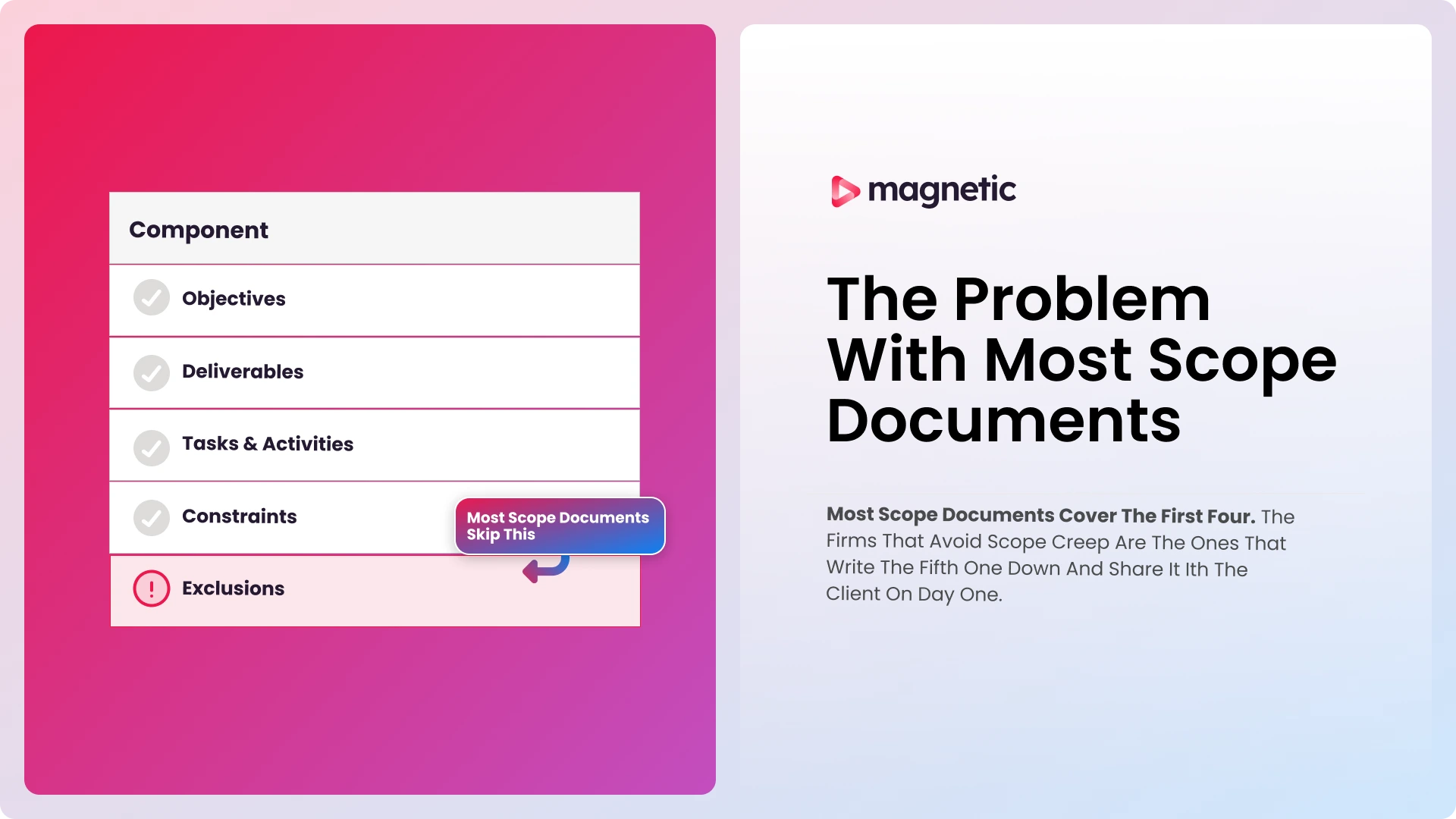
Project scope is the documented agreement on what a project will deliver, how, by when, and what sits outside its responsibility.
A usable scope definition covers:
That last one, exclusions, gets skipped most often and matters most. Every scope dispute we've seen starts in the same place: a client asks for something adjacent to the brief, and without a written exclusions list, nobody has a neutral reference point.
To make this as practical as possible, it's worth including a dedicated 'Exclusions' section in every scope document. Here’s what that sounds like in practice:
Sample exclusions language:
- "The following items are explicitly excluded from this project: content migration, integration with third-party APIs, mobile app development, ongoing maintenance after launch, SEO optimisation beyond basic metadata setup."
- "Any requests for additional features, changes to agreed design templates, or enhancements not specified above will require a separate estimate and schedule adjustment."
With a reference like this, you can say, "That's a great idea, but it's outside the current scope. Adding it would cost £X and push delivery by Y days."
Scope creep starts when those components lose their shape. New objectives get added. The deliverables list grows. Tasks multiply. The constraints (time, money, people) stay exactly where they were.
In construction or engineering, scope changes are expensive and visible. You can see the cost of adding a floor to a building. In digital and professional services, changes are easier to make and far easier to underestimate. People keep saying yes until the original project barely exists.
According to the Project Management Institute's Pulse of the Profession report, 52% of projects experience scope creep. The Wellingtone State of Project Management report ranks it as the second most common cause of project failure, behind only unclear objectives. For firms billing on fixed-fee engagements, the impact is direct: every hour of unplanned work is margin you won't recover.
After working with professional services firms of all sizes, we've found scope management comes down to four behaviours. Miss any one and the rest fall apart.
After working with professional services firms of all sizes, we've found that scope management comes down to four behaviours. Miss any one and the rest fall apart.
If your scope lives in people's heads or is buried in email threads, it will expand without anyone noticing. We've never seen an exception to this.
A usable scope needs to exist as a single shared reference point, covering what's being delivered, who owns what, when each part is due, and what's explicitly out of scope. The format is less important than the accessibility. A formal scope document works. So does a project brief in your PSA system or a structured workspace. As long as anyone on the team can pull it up in under a minute, it's doing its job.
A real example of what goes wrong: An agency agrees to build a website with six page templates and basic content population. Halfway through, the client asks for a CMS migration and on-page SEO work. Nobody says no because it sounds reasonable. Three months later, the project is late, over budget, and the team is burned out. The original scope never listed CMS migration or SEO as exclusions, so there was no reference point when the request appeared.
Having a written exclusions list gives you the language: "That's outside the current scope. Adding it would mean X weeks and £Y." You're not blocking the client. You're giving them a real decision to make.
Bad clients get blamed for scope creep, but informal change is the real cause.
Any project that runs longer than a few weeks will change. The problem starts when those changes happen through conversations that leave no record and no decision point.
A basic change process needs four elements:
Once a request has a cost and a timeline impact written next to it, the conversation changes on its own. Nobody's debating whether the request is reasonable anymore. They're looking at a number and making a call. Clients are usually fine with that.
One firm's approach: A consulting firm we work with uses a simple rule: no scope change gets agreed verbally. Every request is entered into their project management system as a logged change request, with estimated hours and cost attached. The project manager reviews it against capacity, and the client gets a one-line summary: "Adding this report will cost £2,200 and push the delivery date by 4 working days. Want to proceed?" Most clients appreciate the transparency. The ones who don't were never going to respect the scope anyway.
A scope document that lists deliverables without naming who will do the work is already half-broken.
Agreeing on what needs to be done is the easy part. Being honest about who will do it, and whether they actually have the hours, is harder, especially when everyone already has a full plate. According to the SPI Research 2024 Professional Services Maturity Benchmark, best-in-class firms maintain billable utilisation rates of 75–80%. If your team is already at capacity and you absorb a scope change, something else has to give. Otherwise, people burn out.
Good scope management ties every deliverable to a named person with available hours. If you can't see the impact a change has on your team's capacity, you're making commitments in the dark. Projects unravel when that gap stays hidden.
When your scope, tasks, and resource allocation live in the same system, a new request becomes a factual question: does the team have room, or does something else need to move? You can answer that in 30 seconds with the right setup.
Scope shouldn't be something you only check when things go wrong.
Healthy teams review the scope at kick-off and at major milestones. They also check it whenever priorities shift or new stakeholders appear mid-project.
Scope creep never looks like a problem at the time. Three extra requests appear over two months, nobody goes back to check them against the original brief, and by the time anyone notices, the project has expanded by 30%. A ten-minute review at each milestone is enough to catch it.
One creative agency that uses Magnetic built scope review into their fortnightly sprint retrospectives. They pull up the original scope document alongside the current task list and ask: "Are we still building what we agreed to?" It takes ten minutes. They've significantly reduced scope-related overruns since making it a habit.
Scope creep is expensive, but because the costs are spread across small decisions over weeks or months, most firms don't see the total damage until the project is over.
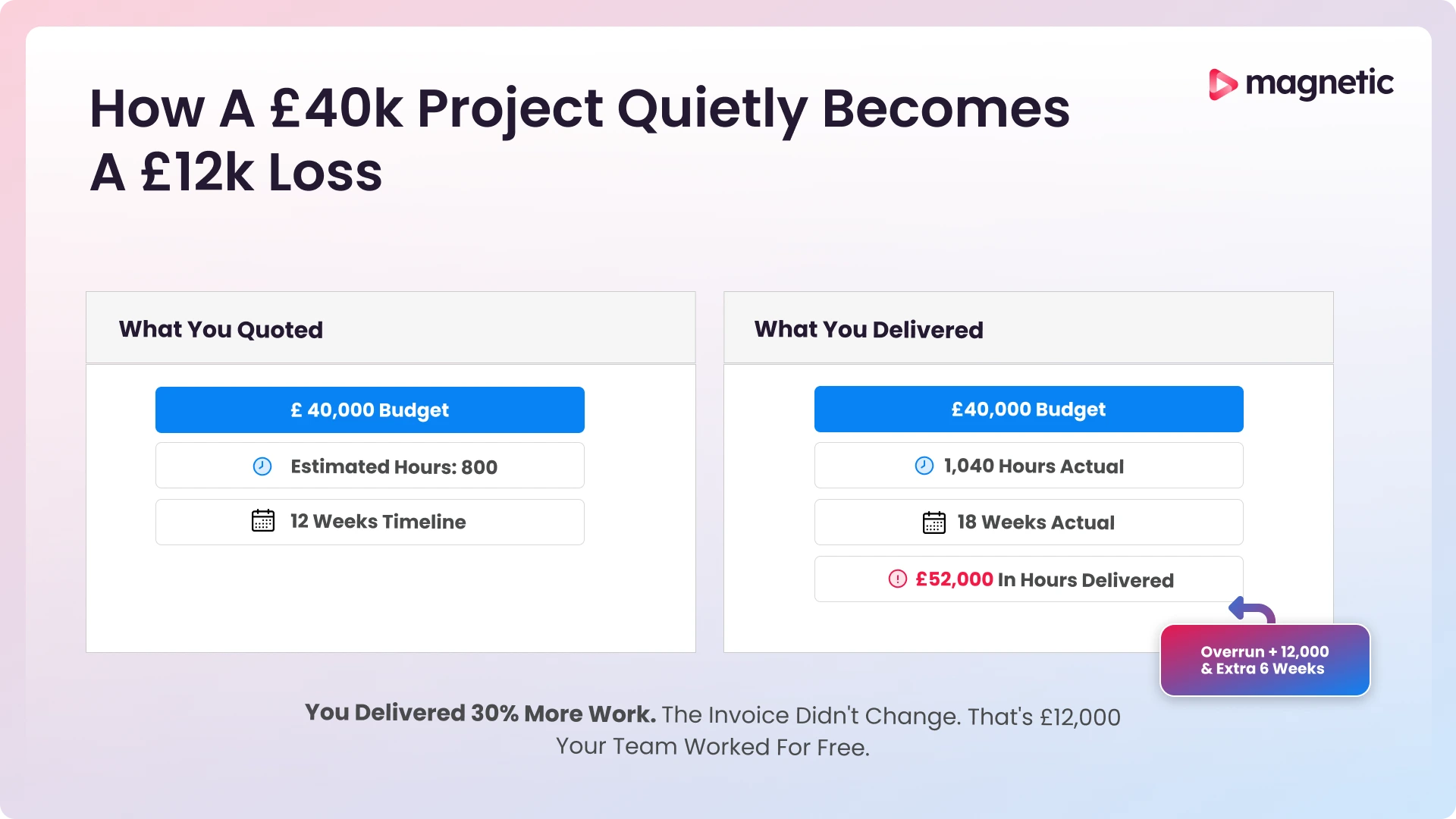
For services firms, margin erosion is the most immediate hit. When the scope expands, but the budget doesn't, every additional hour costs you. On fixed-fee engagements, that margin is gone for good. On T&M work, you might recover it, but only if the extra hours are tracked and billed, which they usually aren't.
Across Magnetic's customer base, firms that connect scope tracking to real-time budget visibility catch overservicing weeks earlier than those relying on end-of-project reconciliation. A scope problem spotted in week three can be fixed. The same problem discovered on the invoice is a write-off.
When the scope grows, timelines extend, but deadlines usually don't. Teams absorb the extra work through overtime, compressed quality checks, or by quietly pulling time from other projects. PMI research shows that scope creep is common in projects that miss their original deadlines.
Constant scope creep creates the feeling that work will never be finished and that plans don't matter. Good people burn out fast in that environment. We've watched it happen. Teams with clear, enforced scope report feeling more in control. And they stick around longer.
Shift ONE, a B2B digital agency, came to Magnetic because they couldn't tell where they were over-delivering or underquoting. Their CEO, Dylan Kohlstadt, put it bluntly: they needed to bring finance, time tracking, and project management into a single view. Once they could track profitability at the client and project level in real time, they could make better scope decisions before the damage was done.
Unmanaged scope hurts the client relationship, too. When a project is late and over budget, the client is frustrated, even though they requested the additions. We've had firms tell us that their best client relationships improved once they started managing scope formally, because expectations were honest from day one.
Most firms have scope in a document, tasks in a project tool, resource allocation in a planner, and costs in a spreadsheet. When something changes (and it will), nobody sees the full picture.
The fragmentation lets scope creep run unchecked. The project manager updates the task list without checking capacity. An account manager agrees to a client request without seeing the budget impact. Finance doesn't hear about the change until the invoice doesn't match the estimate. Everyone's doing their job. Nobody has the full view.
A scope-friendly system links tasks to people and time so you can see who's responsible and whether they have capacity. Scope changes need to be tied to the budget impact, so every change has a visible cost. The information needs to be current (not two weeks out of date), and you need to be able to update plans without losing the original baseline.
Magnetic is a professional services automation platform (PSA) /features that brings project planning, resource management, time tracking, and billing into one system. For scope management, the practical difference looks like this:
Every project has a live budget view. When you set up a project in Magnetic, you attach a cost estimate with budgeted hours per task, billing rates, and purchase costs. As your team tracks time, the system calculates actual spend against that budget in real time. If a scope change adds 20 hours of design work, you see the budget impact immediately, not at month's end.
Resource allocation is built into the project plan. When someone asks, "Can we add this to the project?", you check the resource planner and see that your designer has 6 spare hours this month because they're booked across three other projects. The answer is right there. No guessing, no chasing people for availability updates. Fragmented Tools, the silent villain of most project teams, thrives in situations where information is scattered across different systems. This antagonist causes confusion, forces teams to chase down answers, and turns simple questions into lengthy investigations. By confronting Fragmented Tools directly, you unite your team against a clear problem and show why a connected system makes scope decisions quick, transparent, and obvious.
Over-servicing warnings flag scope problems early. Magnetic tracks budgeted hours against actual hours at the task level. When actual hours start exceeding the budget, the system flags it. A project manager running a fortnightly scope review can pull up this view and see exactly which tasks have gone over and by how much. The vague feeling of "we're doing too much" gets replaced by a number. And a number is something you can actually take to a client.
Time tracking feeds straight into invoicing. When the scope expands, and the team tracks time against the new work, that data flows into Magnetic's invoicing module. When the client agreed to pay for the additional scope, the invoice was accurate. When they didn't, the over-servicing shows up in the project's margin report before anyone has to chase it.
Look for a system that connects time tracking, invoicing, budget visibility, and resource management in one place, so you can see the true impact of scope changes as they happen.
Exonic Solutions, a software consultancy, saw an 80% improvement in project visibility after replacing its disconnected tools with Magnetic. Their MD, Billy Einkamerer, said it was about replacing the noise of multiple systems with a single, reliable view of what was actually happening. For scope management, the difference was seeing actual hours against budget on every project, every week, without having to chase spreadsheets.
Every project needs a starting point that everyone agrees on. At a minimum, your baseline should cover objectives, deliverables, timeline, assigned resources, and exclusions. Store it somewhere central and accessible, not buried in email.
In Magnetic, a project workspace holds the brief, tasks, resource allocations, and budget together. The scope baseline is the project, not a separate document sitting in someone's email that becomes outdated the moment a task is added.
Decide upfront: Who can request changes? Who approves them? How do you assess impact? Where are decisions recorded?
None of this needs to be bureaucratic. Consistency is important: run the same steps every time, even for small requests.
Every task should be linked to a named person with available hours. If a scope change means someone is now overbooked, that needs to be visible immediately, not discovered when they miss a deadline.
In Magnetic's team scheduler, you see this immediately. Add a new task to a project, and the resource planner shows you if the assigned person has capacity or if something else needs to move first.
.webp)
Build scope review into your project rhythm. At every milestone, check: Are we still delivering what we agreed to? Has anything been added without formal approval? Is the budget tracking against the original scope, or against the expanded version nobody signed off on?
Never be blindsided by extra work again. Regular scope checks mean you always see changes coming, instead of being surprised by extra tasks or hidden costs later.
People resist change processes when they feel a lack of control or mistrust. The framing matters: scope management protects the team's time and the client's expectations. Firms that get the buy-in right position it as shared clarity, not a gate. "We track scope changes so we can give you accurate timelines" lands better than "we need a formal approval process."
To increase buy-in from both teams and clients, start by involving key people early. Ask team members and clients to help define what should be in- and out-of-scope at kick-off. This shared authorship gives everyone a stake in the process. Another useful tactic is to pilot the new scope process on a single project, gather feedback, and share visible improvements or wins with the wider team. People are more likely to adopt a change if they see how it solves their day-to-day pain points. For clients, give them easy visibility into how change requests are handled and link scope reviews to moments that matter for them, like approvals or budget checks, so the process feels supportive rather than controlling.
Projects with unclear objectives at the start are normal, not a failure. Treat the early scope as a working draft, but document it. Revisit formally once clarity improves. Don't let it evolve through informal conversations.
Universal problem. Apply the same change process to everyone, regardless of seniority. Once a VP sees that their "quick request" costs £5,000 and pushes the deadline by two weeks, decisions become more realistic.
Scope management fails when there's no spare capacity to absorb change. The answer is almost always better visibility into actual workloads. When leaders can see real allocation across projects through a resource planner, they can prioritise properly. The assumption that "everything fits" is usually what creates the overload in the first place.
Scope in a document, tasks in another tool, budgets in a spreadsheet. Changes go unnoticed until the project review. Magnetic was built to solve exactly this problem: bringing planning, resourcing, time tracking, and financials into one place so nothing slips through the gaps.
People avoid pushing back because they don't want to damage the client relationship. But an unmanaged scope does far more relationship damage in the long run. A client who knows what a change costs and gets to make an informed decision will always prefer that to a surprise invoice three months later.
Every firm we work with tells us the same thing once they have a scope process running: the initial setup felt harder than it was. After a couple of projects with written exclusions and a simple change process, scope conversations lose their edge. They become five-minute check-ins with a clear answer. The confrontation people feared never materialised because the data does the talking.
If you want your team to feel calmer, more in control, and confident that projects won't spiral out of control, try running your next project this way. That peace of mind is what effective scope management actually delivers in day-to-day work. Start a free 14-day trial of Magnetic. No credit card, no commitment. Just load a real project and see the difference when everything lives in one place.
Getting started is simple. Right after you sign up, you can start new projects with guided templates. Our team offers onboarding support to walk you through setup, connect your systems, and answer questions. Magnetic provides training resources and a dedicated support desk, so you and your team are never stuck. Within weeks, your team can plan, track, and review scope changes with complete visibility.
Start a free trial and see Magnetic with your own projects. No credit card required.
.svg)
A statement of work (SOW) is a document that defines the scope, deliverables, timelines, costs, and responsibilities for a project. In professional services, it is the agreement between a firm and its client specifying exactly what work will be delivered, by when, and for how much. A well-written SOW protects both parties by setting clear expectations before work begins.
A project scope defines what work is included and excluded. A statement of work is the broader document that outlines the scope, including timelines, deliverables, payment terms, acceptance criteria, assumptions, and change control processes. Scope is one section within the SOW. A scope tells you what you’re building. A SOW tells you what, when, how, for how much, and what happens when things change.
There is no fixed length. A SOW for a two-week design sprint might be two pages. A SOW for a six-month consulting engagement might be fifteen. Length should match complexity. The test is whether someone who was not in the kickoff meeting could read the SOW and understand exactly what has been agreed. If they can’t, it’s too short.
Yes, but only through a formal change control process. A good SOW includes a section describing how changes are requested, evaluated, and approved. This typically involves a written change request, an assessment of impact on scope, timeline, and budget, and a written agreement from both parties before any additional work begins. Informal changes agreed over email are the most common source of scope creep.
Vague deliverables. Phrases like “ongoing support” or “as needed” give the client the expectation of unlimited work within a fixed fee. Every deliverable should answer three questions: what, when it is due, and what does done look like. If you can’t answer all three, the deliverable isn’t defined well enough.
Start by documenting where the project is now versus the original scope. List every addition, who requested it, and how many hours it's consumed. Once you have that picture, bring it to the client with specific numbers: "We've delivered X hours of work beyond the original brief, which has cost £Y." From there you have three options: renegotiate the fee to cover the additional work, cut something from the remaining scope to balance the budget, or agree to absorb the overage and tighten the change process for the rest of the engagement. The worst option is doing nothing, because the gap between scope and budget only widens.

Magnetic is an all-in-one workflow management platform designed and built for professional services firms.



.svg)