US




Taxability follows the deliverable and the state, not the industry. Two agencies with the same clients can have different obligations because one sells design and the other sells strategy.
As of 1 October 2025, Washington taxes advertising services, custom website development, IT services, custom software, live presentations, and temporary staffing. Connecticut taxes creative advertising work and website development. Texas taxes data processing, which includes website creation and maintenance.
California, New York, Florida, and Illinois generally do not tax the services agencies sell. Illinois changes that on 1 January 2027 for targeted advertising.
Hawaii and New Mexico tax the business, not the customer, and let you pass the tax on.
A tax you should have collected but did not is your cost. On a $50,000 project with a 40% margin, absorbing a 9% tax drops the margin to 31%.
Nexus can put you under a state’s rules without an office there. The threshold in South Dakota is $100,000 in gross sales into the state.
Most US states do not charge sales tax on services. That is the answer on most pages and why many agencies never set up tax collection. It stopped being safe on 1 October 2025, when Washington made advertising, custom website development, IT services, and custom software subject to retail sales tax. Connecticut, Texas, and Hawaii already cover parts of an agency's work, and Illinois has announced targeted advertising will be taxable on 1 January 2027.
This guide covers the rules for deliverables agencies sell in 14 states and the District of Columbia. For each, we link to the state's page so you can check the rule yourself. We also cover how uncollected tax affects your margin and how to set up billing and time tracking to keep taxable and non-taxable work separate. It is written for agency owners and finance managers and is not tax advice. Rules change, so a CPA or state tax adviser should confirm how they apply to your contracts.
Every state page on this topic comes back to the same four questions. Answer them in this order.
Start with what you sold, not who you are. A state may tax the design of an advertisement and not the strategy behind it. It may tax building a website but not consulting on it.
Most states tax based on where the customer receives or uses the service. Washington's website development guidance is explicit that liability depends on where the customer receives the service, and New Mexico's tax reaches services performed outside the state if the product is first used there. Your own address matters less than your client's.
Nexus is the connection that makes a state entitled to ask you to collect. It used to require a physical presence. It no longer does, as the next section covers.
A retainer that mixes strategy, creative production, and reporting may contain taxable and non-taxable parts. States differ on whether you can separate them and whether a separate statement on the invoice protects you.
The table below groups typical agency deliverables and shows how the states covered in this guide handle them. This table is a reference guide, not a legal determination. The state table below includes links.
If you place contractors with clients, read the classification rules first. Our guide to 1099 vs W-2 for agencies explains how the staffing model changes cost and billing, and Washington's new staffing rule adds a tax question on top.

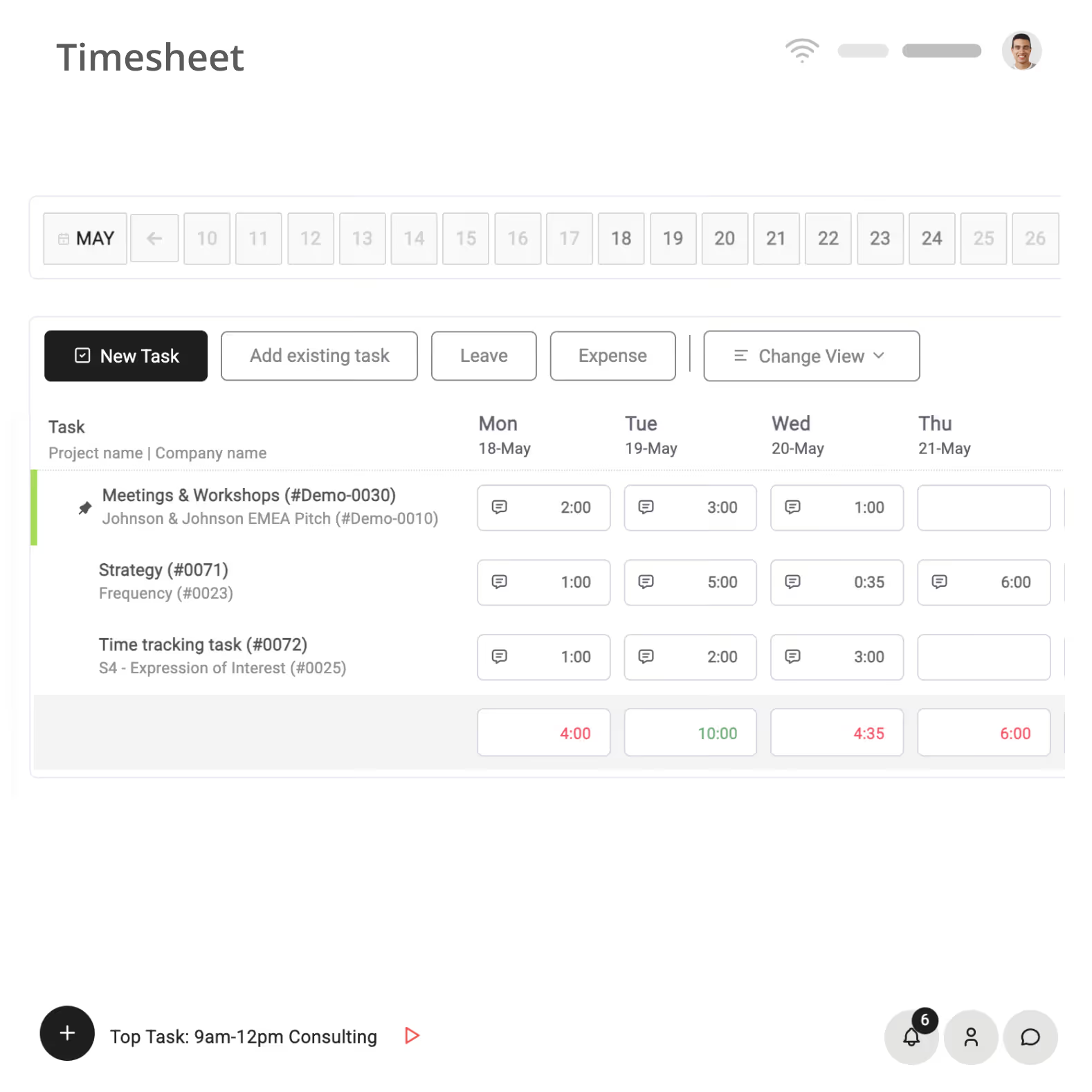
See the hours behind every task, project and client
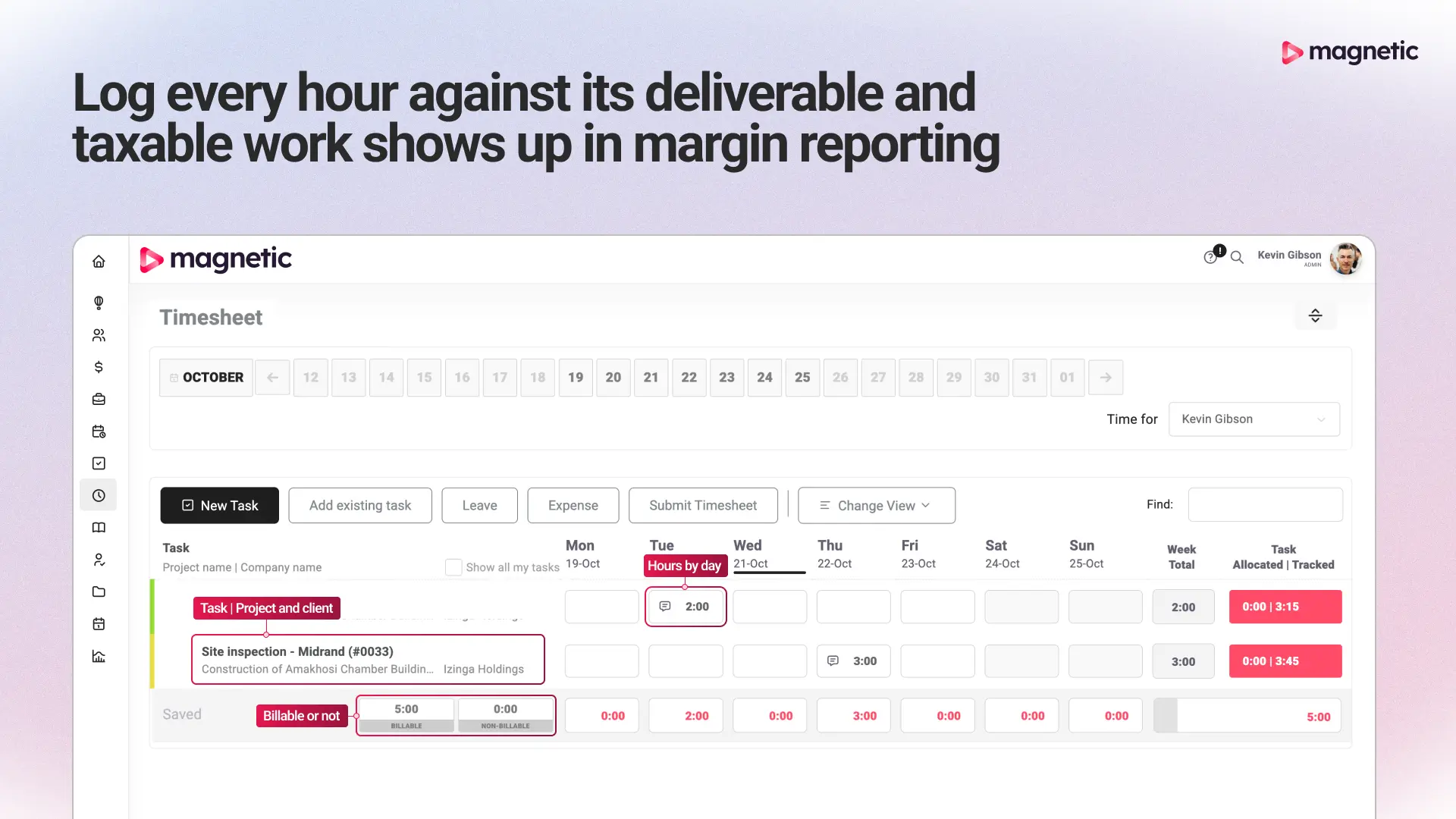
Every time entry in Magnetic links to its task, project and scope.
The table covers 14 states and the District of Columbia, selected either because many US agencies are based there or because the rules differ in a significant way. Each row links to the state's own page. We checked every page on 28 September 2026. Confirm the date on the page before you rely on a row.
Two things stand out. First, the states that tax the most agency work do it in two primary ways. Washington and Connecticut name advertising and website work outright. Texas and Ohio reach agency work through data processing and information services, a narrower, more fact-specific door. Second, in the states that stay silent, the silence is often a gap in the page, not a clearance. Ohio and DC do not mention marketing at all, and both tell you to check.
If your state is not in the table, start with its revenue department's list of taxable services. The Federation of Tax Administrators keeps a survey of how states tax services, though its own notes say it does not rank states by how much they tax.
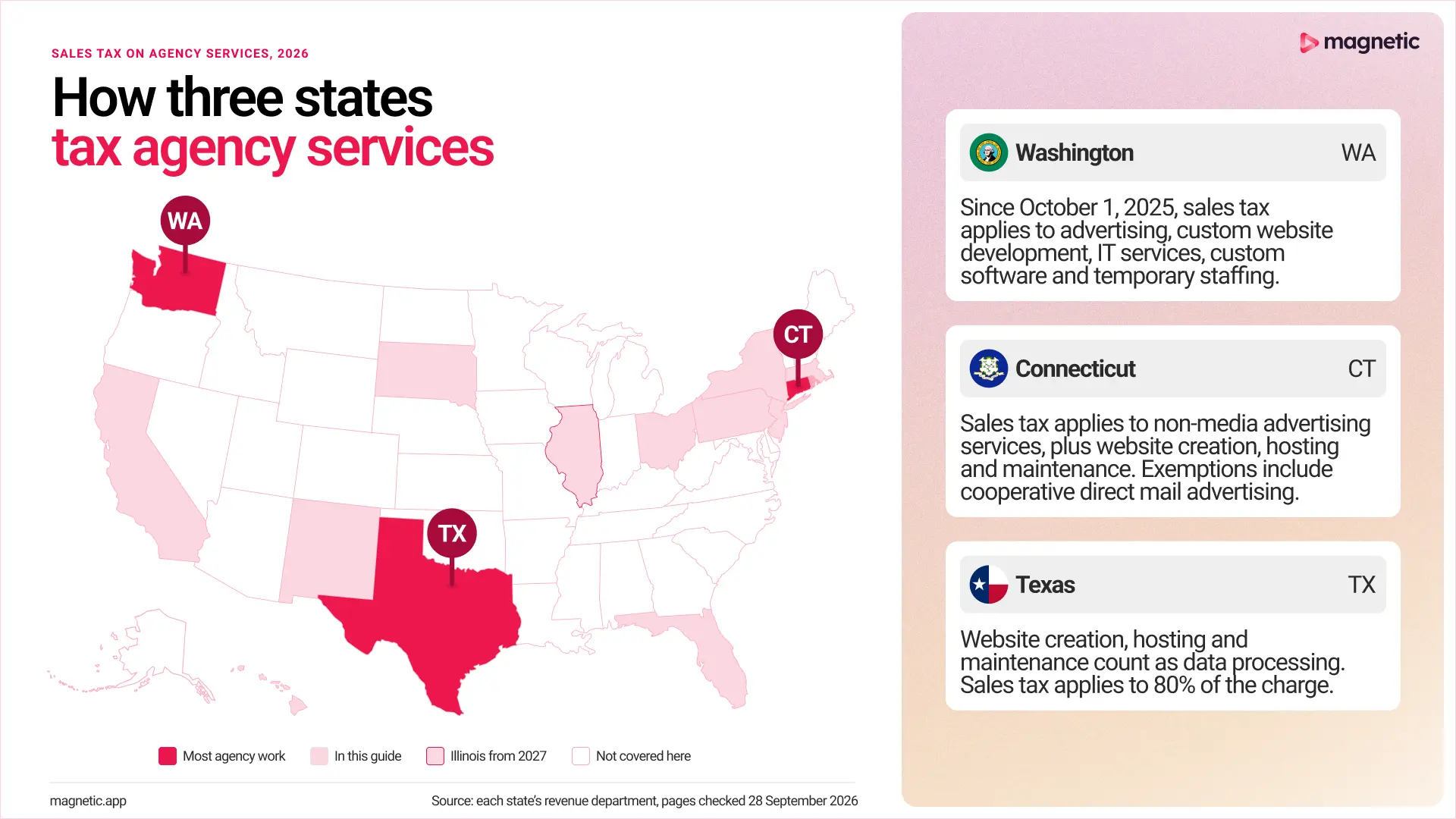
Washington is the clearest example of a state moving quickly, and it warns what other states may do. The Department of Revenue's guidance on advertising defines the service as covering "all digital and nondigital services related to the creation, preparation, production, or dissemination of advertisements." That includes layout, art direction, graphic design, search engine marketing, lead-generation optimization, and web campaign planning. Broadcasting, newspaper publishing, printing and publishing, out-of-home advertising, web hosting and domain registration sit outside it.
For an agency, the effect is two taxes on the same invoice. Retail sales tax goes on top of the fee, and the retailing B&O tax applies to your gross income with no deduction for labor, materials, or costs. The B&O tax is yours, not your client's. If you priced a 2025 retainer assuming no B&O, the margin is lower now.
Existing contracts were not exempt forever. Payments received before 1 October 2025 kept the old treatment. Sellers could report contract income under the old rules through 31 March 2026, and reporting periods starting on or after 1 April 2026 fall under the new ones. A material change to a contract, such as a scope expansion or a price adjustment, brings it under the new rules at the time of the change. If you have a Washington client, look at your renewal dates.
Washington also gives an agency model a reseller route. Where you are contractually responsible for a subcontractor's services, and there is no intervening use, a reseller permit may apply to what you buy from that subcontractor. Review the interim guidance with your CPA before relying on it, since the department plans to replace the interim statements with final guidance.
The old rule was that a state could only ask a business to collect tax if it had a physical presence there. In 2018, the Supreme Court overruled that in South Dakota v. Wayfair. The South Dakota law the Court reviewed applied to sellers that deliver more than $100,000 of goods or services into the state, or engage in 200 or more separate transactions a year. The Court found the nexus requirement satisfied.
States have set their own thresholds since. South Dakota's current guide uses $100,000 in gross sales into the state. For an agency, the practical question is whether you have a client base concentrated in one state that also taxes what you sell. A firm that sells a taxable deliverable to a few Washington clients has an obligation there whether or not it has ever set foot in Seattle. A firm that sells strategy to clients in New York and California may have no tax to collect at all.
The steps are simple. List your clients by state, mark the states where you sell a taxable deliverable, and compare each state's revenue against its threshold. If you cross one, register before the state contacts you. Registration is a form. An audit is a much longer conversation.
A clean invoice is your best defense in a tax review, and it also makes it easy to charge for a taxable deliverable. Four habits cover most of the risk.
State taxable and non-taxable work on separate lines. In states that treat the two differently, a single blended fee gives the state room to tax the whole thing. Massachusetts, for example, exempts custom modifications when charges are separately stated and reasonably allocated in good faith. Where a state taxes gross income with no deductions, as Washington does, separate lines still help you show what the taxable part was.
Keep resale documentation for anything you buy to resell. If a subcontractor's work goes into a deliverable you sell, a reseller certificate on file with the subcontractor is what lets you buy that work without paying tax on it, in the states that allow it.
State the tax separately where the law asks. New Mexico requires that a passed-on gross receipts tax appear as a separate line. Hawaii counts a passed-on tax in your gross receipts. Both are easy to get wrong when the tax is buried in the fee.
Keep the contract and the invoice consistent. Pennsylvania's guidance says tax law deals in economic realities, not legal abstractions. A contract that calls a website a service does not change what happens to it if it ends up with the client.

Turn approved hours into invoices at the right billing rate
Rates apply per person, project or rate card, with no manual exports to your accounting software.
Free for 14 days · No credit card required
Tax sits on the finance side of an agency, and it exposes a common gap: many firms cannot split work by deliverable type. To know what part of a retainer was design, what part was strategy, and what part was hosting, you need to track time against the deliverable, not just the client. Our piece on time tracking in professional services shows how agencies, consultancies and engineering firms set that up differently. Timesheets that record the deliverable make the taxable split a report, not a reconstruction, and Magnetic's timesheets and finance management features are built around that link between time, billing, and project profit.
Once you know the split, you can price with it. A Washington client's website project now carries B&O tax on gross income, which is a cost. Our guide to project profitability strategies for agencies covers how to build cost like that into a quote, and our profitability calculator lets you test the effect on margin before you send it. For the fully loaded cost of the people delivering the work, see The True Cost of a Billable Employee. For how your margin compares with the rest of the market, see our US professional services profit margin benchmarks. If billable hours are how you bill, the guide to mastering billable hours is the place to check your rate assumptions.
Pull your client list and sort it by state. Mark the states in the table above where you sell a taxable deliverable. If any are Washington, Connecticut, or Texas, check your contracts and invoices first. Then look at your time entries and confirm you can separate design, strategy, and development work by client. If you cannot, that is the gap to close before the next quote goes out.
Then take the list to a CPA or state tax adviser. Sales tax law is specific to your contracts, your clients, and your state, and only an adviser who has read them can tell you what to charge. The state pages above are the source of truth, and each one carries its own date.
If you want to see how your time, billing, and project profit sit together in one place, book a demo.
Get Started with Magnetic
Start a free trial and see Magnetic with your own projects. No credit card required.
It depends on where the client receives or uses the service, and on whether you have nexus in the client's state. Washington taxes based on where the customer receives the service, and New Mexico taxes services performed elsewhere when the product is first used there. Your own address matters less than your client's.
The billing method does not decide taxability. The deliverable and the state do. Pennsylvania's guidance says tax law looks at economic realities, not legal abstractions. An hourly invoice for website development in a state that taxes website development is still a taxable sale.
In Hawaii and New Mexico, yes, though Hawaii makes it optional. New Mexico requires the passed-on tax to appear as a separate line on the invoice. Hawaii treats a passed-on tax as part of your gross receipts. Both states place legal liability on the business, so if you don't pass it on, you still owe it.
If you resell a subcontractor's work as part of your own deliverable, a resale or reseller certificate can let you buy that work without paying tax on it. Washington's guidance ties this to being contractually responsible for the subcontractor's services with no intervening use. Requirements vary by state, so confirm yours before you ask a subcontractor to accept one.
More often than most agencies expect. Washington changed on 1 October 2025, Illinois says targeted advertising becomes taxable on 1 January 2027, and DC's rate rises from 6.0% to 7.0% on 1 October 2027. Check the date on each state page before you rely on it, and review your tax setup at least once a year.
Some clients are exempt, such as nonprofits and government bodies, and they give you a certificate that lets you leave tax off the invoice. Keep it on file. Without it, the state can treat the sale as taxable and bill you for the tax.
Jenna Green
Head of Growth
at Magnetic
Jenna Green leads marketing at Magnetic. She's worked across agencies, startups, and B2B SaaS, giving her first-hand experience of the operational challenges service firms face.


Magnetic is an all-in-one workflow management platform designed and built for professional services firms.