US
US



Two products share the name. FP&A software (Workday Adaptive Planning, Vena, Planful, Prophix, Jirav, Cube) plans the firm’s budget, headcount and P&L. PSA and resource forecasting software (Magnetic, Kantata, Productive, BigTime, Runn) forecasts projects, people and revenue from live delivery data.
Your revenue is billable headcount × available hours × utilisation × realised rate. A forecast that does not model those four drivers will miss most of what positively impacts your margin.
Under roughly 50 people, your accounting system plus a PSA tool usually covers it. Between 50 and 250, the PSA becomes the operational source of truth and feeds a lighter FP&A model. At 250+ or with several legal entities, you need both, connected.
Most FP&A vendors do not publish prices. One October 2026 pricing guide puts year one at $35,000 to $85,000 all-in. PSA tools mostly publish per-user prices, from about $7 to $30 per user per month.
Test any tool with your own projects, rate cards and a real overrun, not the vendor’s demo data.
A budget that is approved in November, may need revising well before March.Two fixed-priced projects have used more hours than expected and a retainer has started a month late. The spreadsheet you're working from still suggests you're on target because those changes haven't translated to the forecast.
"Budgeting and forecasting tools" cover two different categories of software. Financial planning and analysis (FP&A) plans the firm's budget and profit and loss (P&L). Project and resourcing software uses delivery data to estimate costs, capacity and revenue over the coming weeks. Comparing them in a single ranked list leaves a 40-person agency choosing between products built for very different needs.
Magnetic is a professional services automation (PSA) platform for agencies, consultancies and architecture and engineering firms. We connect pipeline, project delivery and invoicing, so our focus is project and resource forecasting. This guide explains where that type of software is enough, and where a separate FP&A tool becomes useful. It covers both categories with pricing recorded in October 2026.
A search for budgeting and forecasting tools returns products for both financial planning and project delivery. The distinction matters because each uses different data and serves different people
Firm-level FP&A software supports the annual budget, headcount planning, scenario modelling and board reporting. It usually draws data from the accounting system and is managed by finance. Workday Adaptive Planning, Vena, Planful, Prophix and Cube are examples.
Project and resource forecasting software estimates the cost of completing each project, schedules people against future work and includes potential revenue from pipeline deals. Project managers, resource managers and finance teams use it to assess the next few weeks or months and to plan ahead. This category includes PSA platforms such as Magnetic, Kantata, Productive and BigTime alongside resource planning tools such as Runn.
Accounting software provides the financial records used by both. Xero and QuickBooks online offer budgets and comparisons with actual results. NetSuite and Sage Intacct also offer more extensive budgeting and planning capabilities within their financial systems.
Both categories contribute to revenue forecasting. That overlap is why buyers sometimes expect one system can do the work of the other.
We've grouped the tools by later, rather than ranking them in one list, because a ranking across layers isn't meaningful. We chose them because they're the names that come up most often when services firms evaluate this category, they all have a clear fit for agencies, consultancies or A&E firms, and each one either publishes pricing or makes it clear that pricing is quoted based.
Best for: Agencies, consultancies. and A&E firms that want CRM, projects, timesheets, resourcing and finance in one system.
What if forecasts: Revenue by opportunities from pipeline, resource availability and estimated billings; project budgets vs actuals as time is logged; overservicing on retainers, WIP and unbilled revenue.
What it doesn't do: multi-entity consolidation or board-level FP&A modelling. Firms that need those paid Magnetic with an FP&A tool or a spreadsheet model.
Pricing:
Integrations: Xero, QuickBooks, Sage and Pastel for accounting, plus HubSpot via Zapier.
Best for:
What if forecasts:
Pricing:
Best for:
What if forecasts:
Pricing:
Best for:
What if forecasts:
Pricing:
Best for:
What if forecasts:
Pricing:
Best for:
What if forecasts:
What it doesn't do:
Pricing:
Integrations:
Best for:
What if forecasts:
What it doesn't do:
Pricing:
Integrations:
Best for:
What if forecasts:
What it doesn't do:
Pricing:
Integrations:
Best for:
What if forecasts:
What it doesn't do:
Pricing:
Integrations:
Best for: Smaller firms, including those whose accountant handles FP&A. Jirav's guide to FP&A for professional services uses the same four revenue drivers described earlier in this article.
Sage Intacct and NetSuite both build budgeting and planning into the accounting system itself. Netsuite describes collaborative budgeting and what-if modelling as part of its offer for consulting firms. They suit firms that want one financial system of record and are prepared for an ERP-style rollout. Sage prices Intacct by quote and NetSuite doesnt publish a price list either.
Consider a 45-person agency with 36 billable staff. This is an illustrative model, not customer data.
Each billable employee has about 450 hours available in the quarter after holidays are accounted for. At 70% utilisation and a realised rate of £95 an hours, the agency expects 11,340 billable hours an £1,077,300 in revenue. Quarterly costs are £833,400. The FP&A model prepared in January therefore forecasts a margin of 18%.
Five weeks into the quarter, project data shows that the original assumptions need revising:
The extra 877 hours on the fixed-prices projects bring no additional revenue. In this example, those hours would otherwise have been available for other billable work. At £95 an hour, that reduces revenue capacity by about £83,300. The retained delay moves another £25,000 from the quarter.
With costs unchanged, forecast revenue is now at about £969,000 and margin is 8.8%, down from 18%. The extra hours accounted for 7.7% of planned billable time, below the 10.7% average project overrun reported by SPI. The example shows how even an overrun below that benchmark, can materially affect a quarters result.
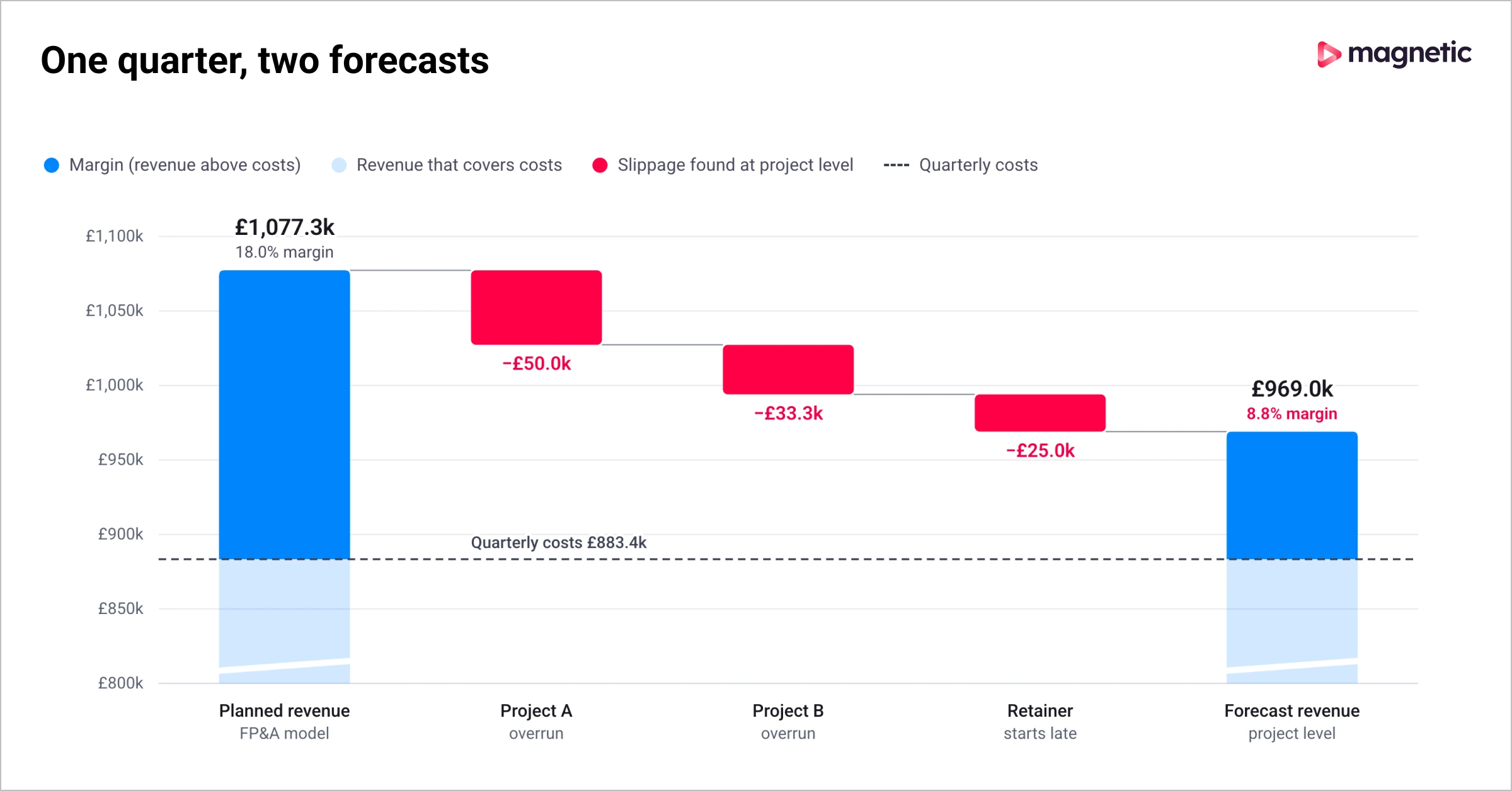
The January FP&A model will continue to show the original result until it received updated project assumptions. Reviewing the project forecast in week five gives the agency time to discuss additional scope with both clients, review wether a senior person is still needed on Project A, and bring forward other work to replace the delayed retainer. Our guide to corrective action in project management explains how to respond when a project needs intervention.
Accurate rates and consistent time records are essential to a useful forecast. Deal with these before introducing more detailed reporting.
Fix rate cards and cost rates first. Agree on the rate card for each client type and a cost rate for each role. Check these before importing project budgets, because an incorrect rate affects every calculation that follows.
Get timesheets in on time. A forecast based on timesheets submitted two weeks late is already two weeks behind. Decide between daily or weekly submission and an approval process that keeps the records current. Our guide to spreadsheet versus automated time tracking explains the impact on reporting.
Establish your triggers. Set thresholds that require a project review. For example, a fixed-fee project that has used 80% of its budget with less than 70% of the work complete should prompt a discussion. Make clear who receives the alert and who is responsible for taking action.
Phase it. Begin with one service line or office. Run it for a month, resolve problems with the data and process, then expand.
Set a cadence. Project leads should review forecasts weekly, with finance updating the firm forecast monthly using the revised project estimates, overheads, and hiring plans. Use the same information for the cash flow forecast, so expected receipts and payments are reviewed along side revenue.
Magnetic connects the information used to forecast project delivery and revenue. Opportunities in the CRM include estimated value and probability. Won work becomes a project with a budget based on your rate cards. As people record time in timesheets, the budget-versus-actual figures update automatically. Resource management shows future bookings and availability and revenue forecasting brings together pipeline opportunities, booked work and available capacity.
The profitability dashboard reports margin by client, project and service, while over-dashboards compare the effort spend on retainers and fixed-fee work against the agreed amount. Approved time and milestones support invoicing, while WIP and unbilled revenue remain visible until billed. Reporting and the accounting integrations with Xero, QuickBooks and Sage, support the transfer of financial records into your accounting system.
.webp)
Magnetic covers project and resource forecasting. For group consolidation or board scenarios across several currencies, you will also need an FP&A tool or a suitable financial model. The delivery data from Magnetic can provide the operational figures that model needs.
Good utilisation means nothing if you're not billing on time. Unbilled WIP might look like progress on a report, but all it really shows is effort that isn't turning into earnings. When teams are managed well, you see it in the numbers, work progresses, invoices go out, and time actually becomes revenue. - Byron Riddle, CFO, Silversoft
To try this with your own figures, start a 14-day free trial. You can also book a demo and bring a project that exceeded its budget so we can work through it with you.
Get Started with Magnetic
Start a free trial and see Magnetic with your own projects. No credit card required.
Because project based revenue is unpredictable, firms in engineering, consulting, and architecture need tools that can actually track billable hours, forecast project costs and allocate resources efficiently. These tools provide greater accuracy and control than generic financial software.
Essential features include seamless integration with existing systems (accounting, CRM, time tracking), robust scenario planning capabilities, real-time data analysis and dashboards, scalability to accommodate growth, user-friendly design that encourages adoption, and the ability to customise workflows and reports to match your processes. For professional services specifically, project-based budgeting and resource capacity planning are non-negotiable requirements.
They provide real-time insights into costs, revenue, and profitability that simply aren't available with spreadsheet-based approaches. With accurate forecasts and automated reporting, CFOs and financial managers can make proactive decisions about pricing, resource allocation, and long-term growth strategies based on current data rather than week-old or month-old information. The visibility to spot project variance early means you can intervene before small problems become major profit issues.
Absolutely. By monitoring billed hours against project estimates in real-time and automating cost tracking, these tools highlight areas where projects risk going over budget before significant damage occurs. This visibility helps firms adjust service delivery, renegotiate scope, or have tough conversations with clients while there's still time to protect profitability. Firms report 30-40% fewer project overruns when using specialized tools versus spreadsheet-based tracking.
Magnetic offers comprehensive finance management as part of an all-in-one platform that also includes CRM, timesheets, project management, resource management, and reporting. This eliminates the data silos and integration challenges that plague firms using multiple disconnected systems. While standalone tools like Workday or Vena may offer more specialized forecasting features, Magnetic provides the advantage of having all your operational and financial data in one platform, giving you a complete view of both financial and operational performance without juggling multiple systems.
Key factors include company size and complexity (don't over-buy or under-buy), integration requirements with existing systems, total cost of ownership including hidden implementation and support costs, scalability to accommodate future growth, and vendor support quality. It's critical to request demos using your actual data and use cases, gather feedback from peer firms in your industry, ensure the tool aligns with your long-term strategic goals, and verify the vendor's financial stability. Most firms benefit from free trials to test with real projects before committing to multi-year contracts.
René Praestholm
Chief Executive Officer
at Magnetic
25+ years in professional services software. Former COO of Workbook Software (15 years) and VP of Global Agency Solutions at Deltek. One of the most experienced leaders in the PSA Software category


Magnetic is an all-in-one workflow management platform designed and built for professional services firms.



.svg)