US


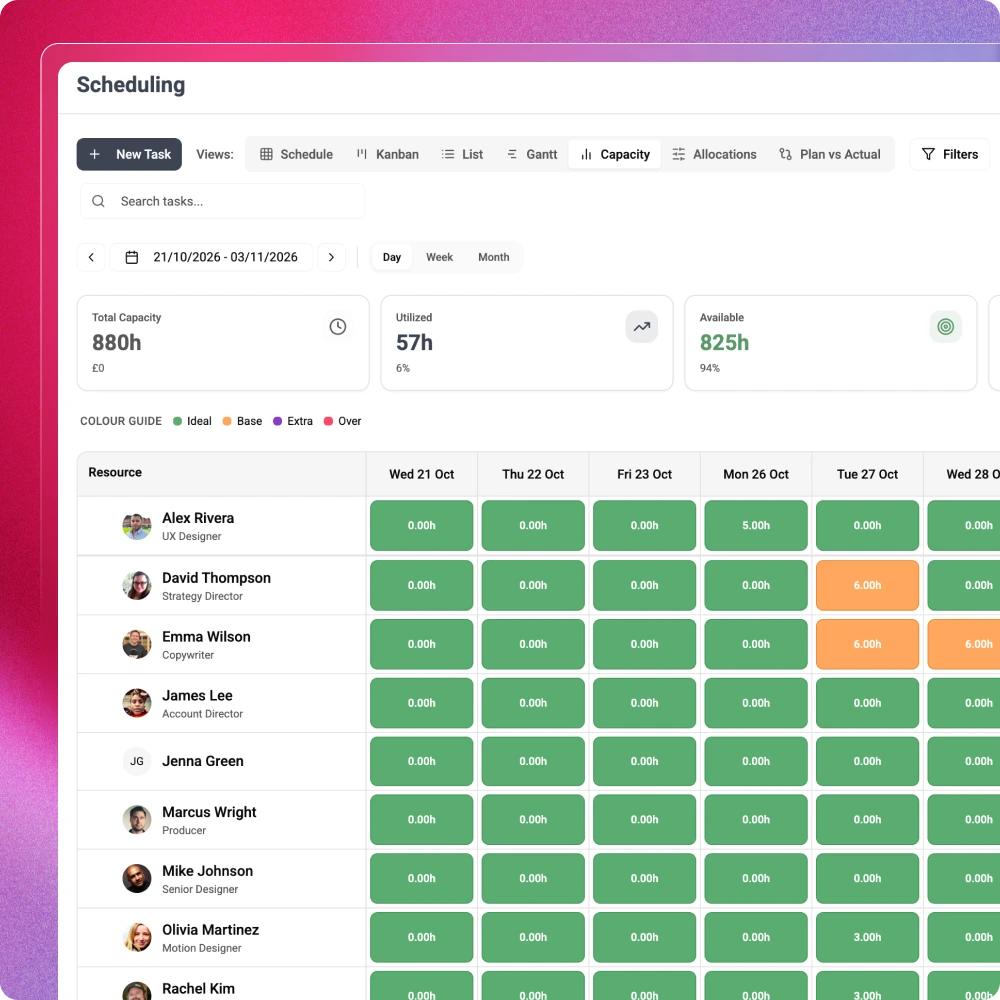

Capacity is contracted hours minus leave, internal time and a buffer for the unexpected. In the worked example below, that leaves an eight-person team about 69% of its contracted hours to book.
Plan six weeks ahead and review weekly, by role. Set confirmed work and likely pipeline against the hours people really have available.
Billable utilisation across services firms fell to 66.4% in 2025, its lowest point in nearly two decades. Much of that gap is a timing problem between sales and staffing.
Plan capacity with your team, not for them. The people doing the work know things no spreadsheet does.
Keep utilisation in a range people can sustain. Employees who usually have enough time for their work are 70% less likely to burn out.
Most agencies, consultancies, and engineering firms hear, “We don’t have capacity,” almost every week, especially when a new project comes in. Sometimes, it’s true. But often, no one really knows for sure, because there’s no single place to see who’s already committed to work, who’s about to go on leave, or what new work is on the horizon.
Capacity planning is how you find out what your team can realistically take on, and what they can't. You set the hours your people actually have over the next few weeks against the work that's confirmed and the work likely to come in, then make decisions while there's still time to act on them: bring in a freelancer, move a start date, or tell sales to push harder. It's one part of managing resources across client projects, and it's the part that protects your margin and your team at the same time.
In a services firm, capacity is time: the hours your people can spend on client work in a given week. Unlike inventory, any hour that isn't scheduled is lost forever; you can't get it back.
Capacity planning answers three questions, every week:
Your job is to manage the gap between available hours and the hours already committed or likely needed for upcoming work. If committed and likely work run above available hours, you have a decision to make about people. If there’s a big gap on the low side, it’s time to look at whether you need to bring in more work. Either way, it's far better to know at the start than to be caught off guard a month later.
Resource allocation comes after this: deciding which named person does which task. Capacity planning comes first because it tells you whether the allocation is possible at all. Our guide to resource allocation strategies for project managers picks up from there.
Without capacity planning, cracks start to show. Deadlines are missed, teams are stretched, and clients begin to question reliability. It’s the same issue every time, just wearing a different mask.
You agree to more work than your team can realistically take on. The contract is signed, but the people needed are already committed to other jobs. Sometimes the project kicks off late. Other times, it starts with whoever happens to be available. Either way, clients notice.
Some people are overbooked, while others sit idle. Billable utilisation across professional services firms fell to 66.4% in 2025, the lowest in nearly two decades of SPI Research benchmarks. A low average doesn’t mean everyone on the team has a light workload. More often, some people are juggling too much while others have little or nothing to do. As Deltek’s benchmark summary puts it, utilisation gaps are "often a forecasting failure before they become a staffing failure."
Burnout leads people to quit. Gallup surveyed nearly 7,500 employees and found that those who usually have enough time to do their work are 70% less likely to feel burned out. By contrast, employees who regularly experience burnout are 2.6 times more likely to look for a new job. When a senior consultant leaves, you not only pay for recruitment and months of onboarding, but you might also lose the client relationships they built.
A revenue forecast only matters if your team can actually deliver the work. If no one checks capacity, those numbers are just sales targets, not a reflection of what’s possible in reality.
Capacity planning won't remove all of this. It shows you each problem early enough to address it.
Start with one team and a six-week window, and work in hours by role.
What's left is bookable capacity. Then set confirmed work and likely pipeline against it.
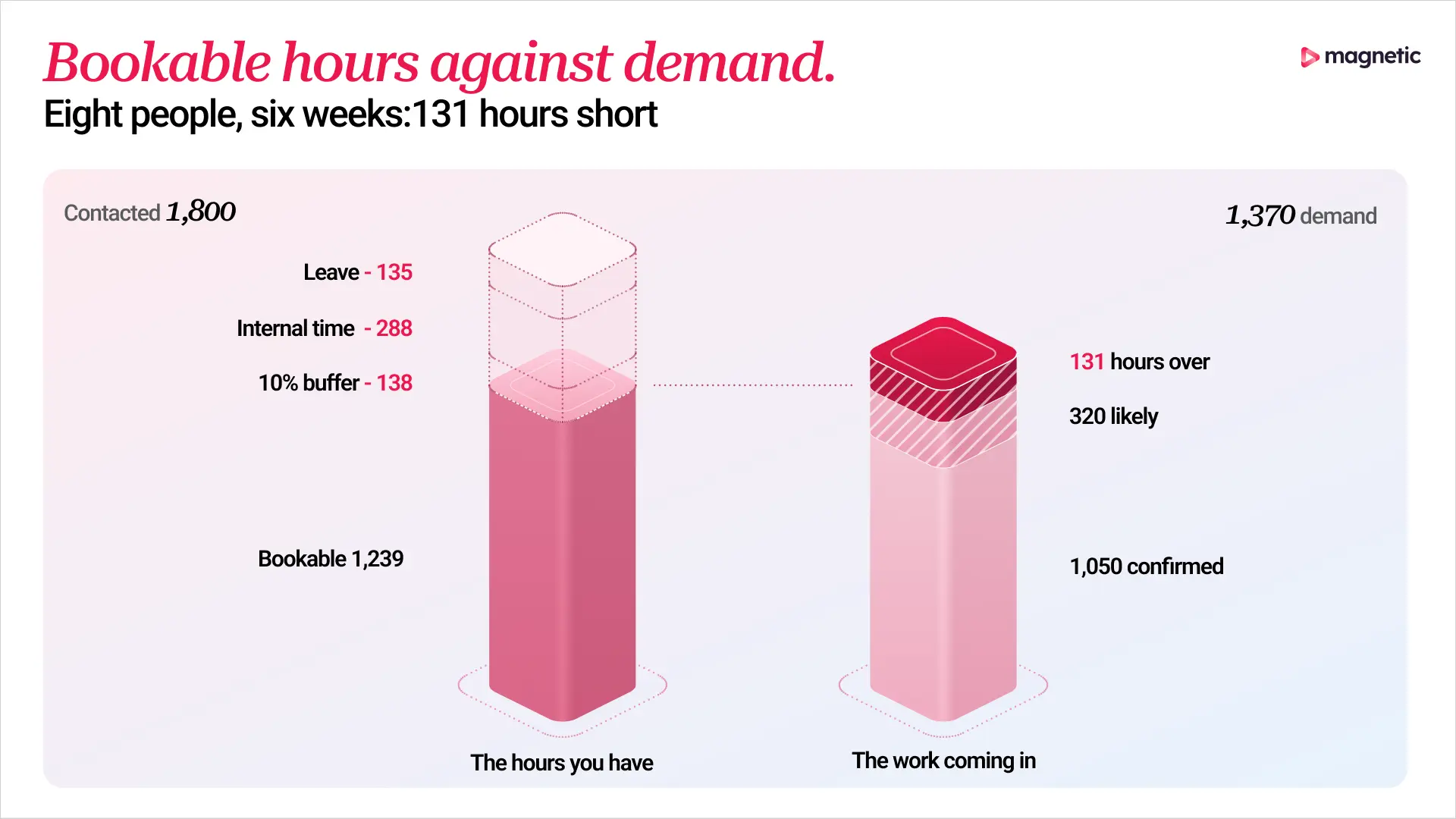
Illustrative figures. Replace them with your own.
The team isn't "out of capacity" in general. It's 131 hours short in this window, about three and a half weeks of one person's time. That's a specific problem with specific fixes: bring in a freelancer, push the likely project start back a fortnight, or ask whether that 50% deal really is 50%.
Check the numbers for each role, not just the team as a whole. You might see everything looks fine overall, but the design team could be overloaded while the strategy department has nothing booked in. Each situation calls for a different solution.
The example also gives you a utilisation check. Bookable capacity of 1,239 hours is 74% of available hours. Booking all 1,370 hours of demand would put the team at 82% for six weeks, above the range most people can sustain for long. Our guide to calculating and benchmarking utilisation rate explains where those ranges come from.
When one person puts together a capacity plan in a spreadsheet, it’s mostly guesswork and formulas. The team on the ground knows what’s missing: clients who delay feedback, jobs that always take longer than expected, or time lost to last-minute pitches. Collaborative planning brings these realities into the plan before they turn into problems.
In practice, it should be a 30-minute resourcing meeting every week, with the same agenda each time.
Whoever manages resourcing, whether that’s a resource manager, operations director, or, in a smaller firm, the founder. Add every project manager or team lead, plus whoever oversees the pipeline. Sales needs a seat at the table too, since upcoming work makes up half the forecast.
Project managers bring a clear picture of how many hours are left on their projects, not just percentages. Team leads add details the plan might leave out, like unbooked leave, someone struggling with a task, or time spent on pitch work. Sales shares which deals are likely to close soon and when those projects could realistically kick off.
If demand exceeds capacity, use the meeting to agree on trade-offs, decide which project to push back, who can step in to help, or whether you need a few extra hands. If someone is overbooked, work out a solution together instead of handing down a decision after the fact.
Hours alone don’t tell the whole story. Juggling two demanding clients in one week can be tougher than spending 40 hours on a familiar project. A quick “Is next week realistic?” during a stand-up can reveal overcapacity that numbers might miss. People are more likely to answer honestly when they know their input will actually make a difference.
Collaborative doesn't mean a committee. When trade-offs conflict, one person makes the call, and everyone knows who that is.
Shared visibility makes this work, especially once people are spread across offices and home. As Isghaack Ebrahim, Implementation Specialist at Magnetic, puts it:

“With hybrid and remote teams, transparency is everything. When leaders can spot workload imbalances or hidden capacity before they become a problem, projects stay on track and teams stay healthier. Magnetic lets you set custom working schedules per person and see their real capacity across every project they’re allocated to, which changes the conversation from guessing to knowing.”
 Isghaack EbrahimImplementation Specialist, Magnetic
A bottleneck happens when work gets held up because one task, person, or approval takes longer than expected, forcing everything else to wait. In service firms, the bottleneck is usually a person; for example, the senior designer who must approve every concept, the only engineer qualified to sign off on drawings, or the partner who reviews every proposal.
Bottlenecks can be hidden in team-wide numbers. A team might average 75% utilisation, but one person is overloaded while others wait for approval. Here are three signs to watch for:
Once you spot a bottleneck, you can address it in a few practical ways: share the load by giving someone else authority to review routine work. Cross-train by pairing another team member with the bottleneck now, before it becomes urgent. You might re-sequence projects so the same person isn’t needed on multiple jobs at once. You can also automate admin by setting up approval reminders and status checks, so you spend time on work only you can do.
Watch for bottlenecks during your weekly meetings. If you catch them early, a quick conversation can fix them. If you miss them, you could miss a deadline.
Looking four to six weeks ahead strikes the right balance. It’s close enough to predict with some confidence, but gives you time to line up a freelancer, adjust a start date, or reorganise the team if needed. For anything further out, plan by role rather than by team member, since specific assignments are likely to change
Book likely deals as tentative work. Every opportunity above a set probability (50% is a sensible line) goes onto the plan as provisional demand, by role and by week. When the pipeline lives in the same system as the plan, as it does in a CRM built for services firms, the forecast updates as the deal status changes.
Plan for roles before assigning specific people. For example, noting “senior designer needed three days a week from the 14th” is enough to see whether the work fits your schedule. Wait until a deal is signed before naming the exact team member who will take it on.
Use your own seasonality. Accounting firms know tax season is coming, and agencies know which months bring campaign peaks. Last year's timesheets for the same weeks are the best guide to next month's demand.
Compare your forecast against what actually happened. Once a month, look at the hours you predicted versus the hours people ended up logging. If new work consistently comes in later or smaller than expected, adjust the probability you use for planning. For a real-time view between meetings, use real-time capacity tracking to stay on top of week-to-week changes.
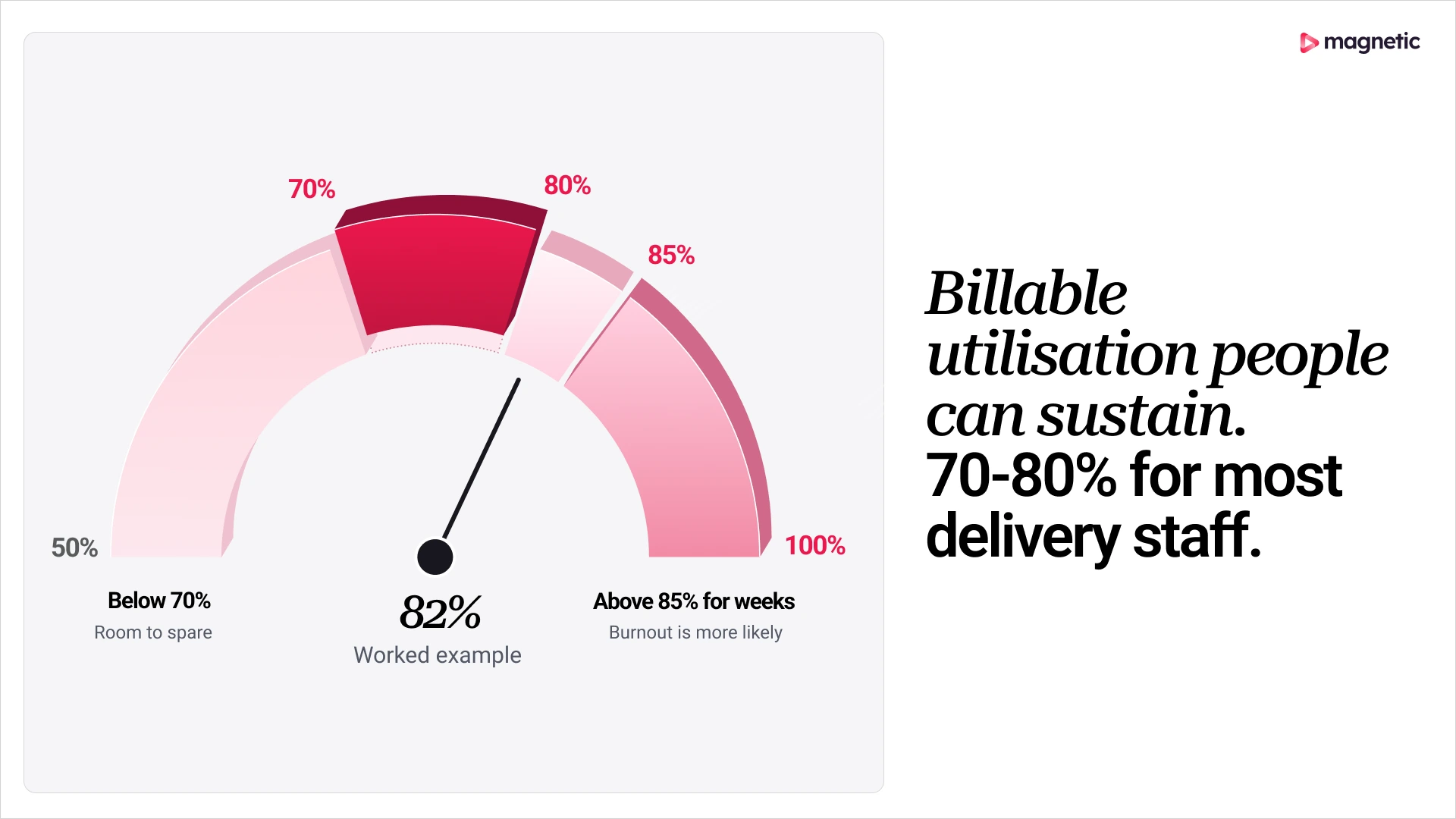
For delivery staff, most firms find that 70% to 80% billable utilisation strikes the right balance between healthy margins and staff retention. If people bill above 85% for more than a few weeks at a time, there’s little room for training or handling unexpected issues; quality can drop, and burnout becomes more likely. Directors and leads who also handle sales or management responsibilities should have a lower billable target, adjusted for their role.
A few rules keep the plan realistic:
Some firms choose to push their teams harder during a major launch or busy growth period, and sometimes that’s necessary. Be clear about how long it will last and communicate the plan up front, rather than letting workloads increase gradually until people burn out or leave.
Next Monday, choose one team and calculate their workload for the next six weeks. Bring those numbers to a quick 30-minute meeting with the project managers and whoever oversees the pipeline. You’ll get a clearer picture of your actual capacity from that single conversation than from weeks of hearing “we’re flat out.”
Resource management in Magnetic lets you book people against real capacity weeks ahead, by role, skill and availability. The system factors in each person’s actual working days, so it counts hours for part-timers or four-day schedules correctly and automatically accounts for leave. Tentative bookings for pipeline opportunities are planned alongside confirmed work, so the six-week view above is a live dashboard rather than a spreadsheet, and the team scheduler flags anyone who is over-allocated in real time.
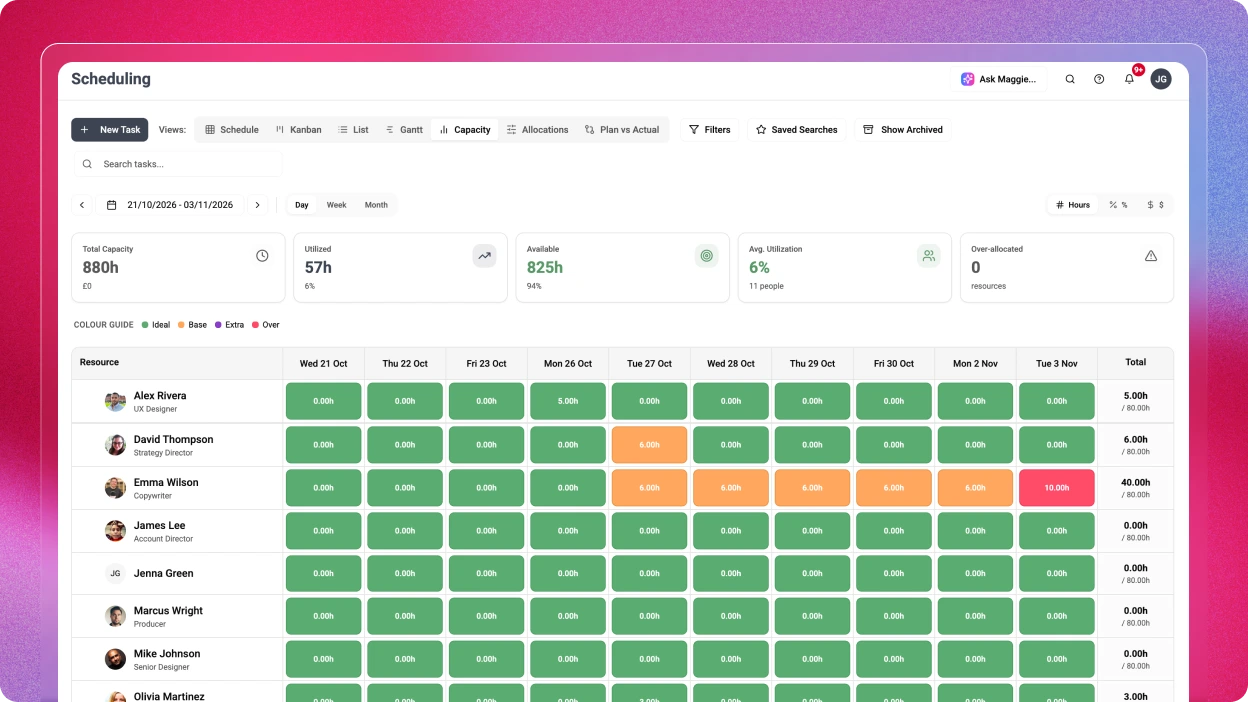
With pipeline, projects, and timesheets all in one place, you can easily compare planned hours to actual hours and track team utilisation in Magnetic’s reporting dashboards. If you manage resourcing, check out Magnetic for resource managers for a practical look at how it all works.
Exonic Solutions, a Johannesburg software consultancy with fewer than 50 people, reported a 50% improvement in scheduling and task management accuracy after moving from disconnected systems to Magnetic.
Book a 30-minute demo to see your own team's capacity for the next six weeks, or start a free 14-day trial.

Yes, but only if the plan changes decisions. A plan that shows someone at 120% and leaves them there does nothing. What reduces burnout is catching overload a few weeks before it becomes a problem, moving work while there's still time, and protecting leave in the plan.
Capacity is the hours someone has available for client work. Utilisation is the share of their available hours that goes on billable work. You plan capacity looking forward, and you mostly measure utilisation looking back, from timesheets.
Weekly for the next four to six weeks, and monthly at role level for the rest of the quarter. Update it straight away when a large deal closes, a project is cancelled or someone hands in their notice.
One named person: a resource manager in larger firms, an operations director or the founder in smaller ones. Project managers own the estimates of work left on their projects, and sales owns the pipeline probabilities. The owner pulls it together and makes the call when trade-offs conflict.
No. In manufacturing and supply chains, it means a company and its suppliers sharing forecasts so they can plan production capacity together. In a services firm, it means planning people's time together, with the team, the project managers and sales in the same conversation.
It should show each person's bookings across every project in one view, account for individual schedules and leave, include tentative pipeline work and flag anyone over-allocated. It also needs to connect to timesheets, so you can compare the plan with what happened. When comparing tools, check how each handles tentative bookings and role-level planning, because those two features make a six-week forecast possible.
Jenna Green
Head of Growth
at Magnetic
Jenna Green leads marketing at Magnetic. She's worked across agencies, startups, and B2B SaaS, giving her first-hand experience of the operational challenges service firms face.


Magnetic is an all-in-one workflow management platform designed and built for professional services firms.