US




RCA in business means root cause analysis: figuring out why a problem keeps happening so you can fix the cause instead of the same symptom again next month.
In a services firm, the root cause of a recurring problem is almost always systemic: a process, a handover, an incentive, or a missing number. "Human error" is usually a symptom.
Run an RCA when the same problem comes back, when a project overruns by more than 10%, or when a client escalates. Skip it for one-offs and problems that cost less to fix than to investigate.
Six steps: define the problem in numbers, pull the data, list possible causes, find the root cause, rank what to fix, then assign an owner, a date, and a success measure.
You've reached the root cause when removing it stops the problem, it's within your control, and you have evidence. If you can't name who changes what, keep asking why.
* Most RCAs fail after the analysis, not during it. A fix with no owner and no review date is a document, not a change.
The website project ran over budget. The previous one did too. For the past three months, the retainer for your biggest client has also exceeded its limit. Every time the team works late, someone promises to be more careful, but the cycle repeats with the next project.
That pattern is what root cause analysis is designed to solve. RCA in business means finding the cause that keeps producing a problem and changing it, so the problem stops coming back. It's one part of a bigger discipline, which we pull together in our guide to corrective action in project management. Here we stick to the diagnosis.
At Magnetic, we spend our days working with agencies, consultancies, and architecture and engineering firms. We get a front-row seat to how projects can unravel. When something goes wrong, people often look for someone to blame. But in our experience, the real problem is almost always hiding in the process itself, not with whoever happens to be in the spotlight.
RCA stands for root cause analysis. It's a structured way to trace a problem past the obvious explanation to what, if you changed it, would stop it from happening again.
Three things it isn't:
The goal is a fix you can act on: a specific change, with an owner, that you can check worked. For a services firm, that usually means changing a process, a template, a handover, or a number someone monitors, because those things repeat from project to project.
You'll also see RCA used in manufacturing, healthcare, and IT operations, where it has been standard practice for decades. The method is the same. In professional services, the real issues often hide in the details: how quotes are written, what gets left out of scope, how timesheets are filled in, or the handoff between sales and delivery.
Too often, teams stop at the first sign of trouble - a symptom that looks like the explanation. But that only scratches the surface. Here’s how the real problems in professional services typically break down, based on what we see week in and week out:
There’s a quick way to check if you’ve found the root cause: if you fix what’s in the middle column, could the same problem happen again? Say you swap your overbooked developer for someone with more availability. Next month, that person will be overloaded too, because nothing changed about how work gets booked in. That’s just treating a symptom. The problem only goes away when you fix what’s in the right-hand column.
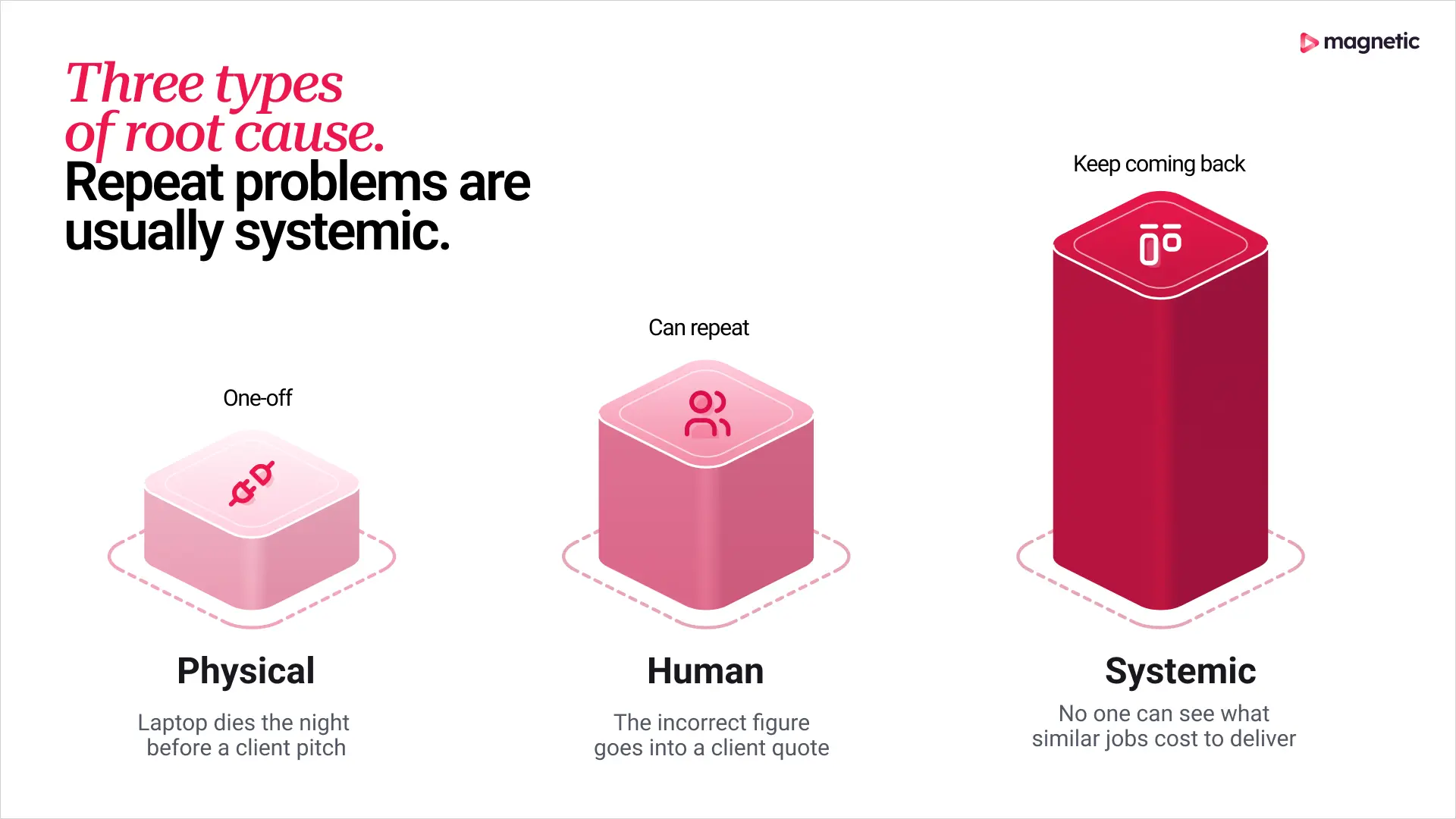
RCA practitioners usually sort causes into three types. IBM's guide to root cause analysis uses the same split:
When a problem keeps recurring, the true root cause is usually systemic. Physical failures tend to be one-offs, and you fix the hardware. Human mistakes do happen, but when the same mistake happens across different projects and with different people, the people aren't the common factor. The system around them is.
This isn’t about being gentle or avoiding blame - it’s just the reality. If three different project managers keep underquoting the same type of job, letting one go won’t fix the problem. You’ll still have the same underquoting, just with a smaller team. The real issue is that none of them can see what the last ten jobs of that type actually cost.
An operations director at one of the 104 agencies in our 2019/20 benchmarking survey put it bluntly: “When things fall apart in an agency, it's because a process wasn't followed”. When a process keeps getting skipped, ask why. Most of the time, the process is too slow, nobody bothers to check it, or it ends up buried in a file nobody ever opens.
If you find yourself blaming “human error,” you probably haven’t dug deep enough yet. Ask what made the mistake easy to make or hard to spot; chances are, you’ll uncover something you can actually fix for everyone.
An RCA takes time from the people who are already stretched, so save it for problems that justify it. Run one when:
That last trigger matters more than it used to. The 2026 SPI Professional Services Maturity Benchmark, covering 509 firms, put average billable utilisation at 66.4%, the lowest in the survey's history, while project margins reached 37.7%. Firms are getting pricing right but losing ground on how much of their capacity they sell and deliver. Falling utilisation is a symptom, and every firm's root cause is different.
Don't run a full RCA when the problem is a genuine one-off with a clear physical cause, when the cause is outside your control (a client's budget freeze, a public holiday), or when the fix is cheaper than the investigation. If a broken laptop lost a morning's work, replace the laptop and turn on backups. You don't need a fishbone diagram for that.
Six steps, sized for a team that has client work to deliver this week.
"The project was late" gives you nothing to investigate. Write down what happened, when, how far off plan it was, and what it cost. For example: "The Acme website rebuild launched 14 days after the contracted date. Design hours came in at 160 against 100 quoted. It's the third website project this year to overrun its design phase by more than 40%."
The last sentence matters most. It turns one bad project into a pattern, and patterns have root causes.
People usually remember the last disagreement, not the actual sequence of events. Before you get everyone together, collect:
If those numbers live in four different tools, this step can take a week. That gap alone is often a cause worth calling out. In our 2019/20 survey of 104 agencies, 57% said they get no real-time alert when a project budget runs over.
Bring everyone involved in the problem together for an hour: sales, delivery, the project manager, and finance if money is involved. Invite someone junior, since they’re often the first to spot where things really go wrong. Write every possible cause down without arguing about it yet. A fishbone diagram (see the methods table below) helps here, because it forces you to look at people, process, tools, client, and data, not just the first theory in the room.
Start with the most likely causes and keep asking why - again and again- until you land on something you can actually change. The Five Whys method, which came out of Toyota's production system, is the simplest way to do this. Five is a guide, not a rule. Stop when you pass these checks:
If an answer fails any of these, you've found a symptom. Keep going.
Sometimes, two issues only become a problem when they are paired together, like an aggressive quote paired with no change process. That's normal. Fix both, and document it in the write-up rather than forcing a single answer.
You'll usually find more causes than you can fix at once. Rank them by how often they show up and what each one costs you. A cause that hits most projects and eats margin goes first. One that's rare but serious, like losing a client's data, goes on the list too. If it doesn’t happen often and doesn’t cost much, save it for later.
For each root cause you're fixing, write down:
Then put the review in the calendar now. More on why in the last section.
This is an illustrative example, built from patterns we see often. The firm and figures are not a real client's.
A 30-person digital agency runs a 60-hour monthly retainer for a retail client. The retainer has come in at 74, 79, and 71 hours over the last three months. Each time, the agency ended up covering the difference -about 40 hours of unbilled work over the quarter.
The obvious explanation: the client is demanding, and the account manager needs to push back harder.
Five Whys:
Root cause: no exclusions in the retainer scope and no change process for retainers, so out-of-scope requests went straight into delivery unpriced. It passes the checks: if you fix it, the problem stops for good, the agency controls it, it's specific, timesheets show the same pattern on two other retainers, and the head of delivery can own it.
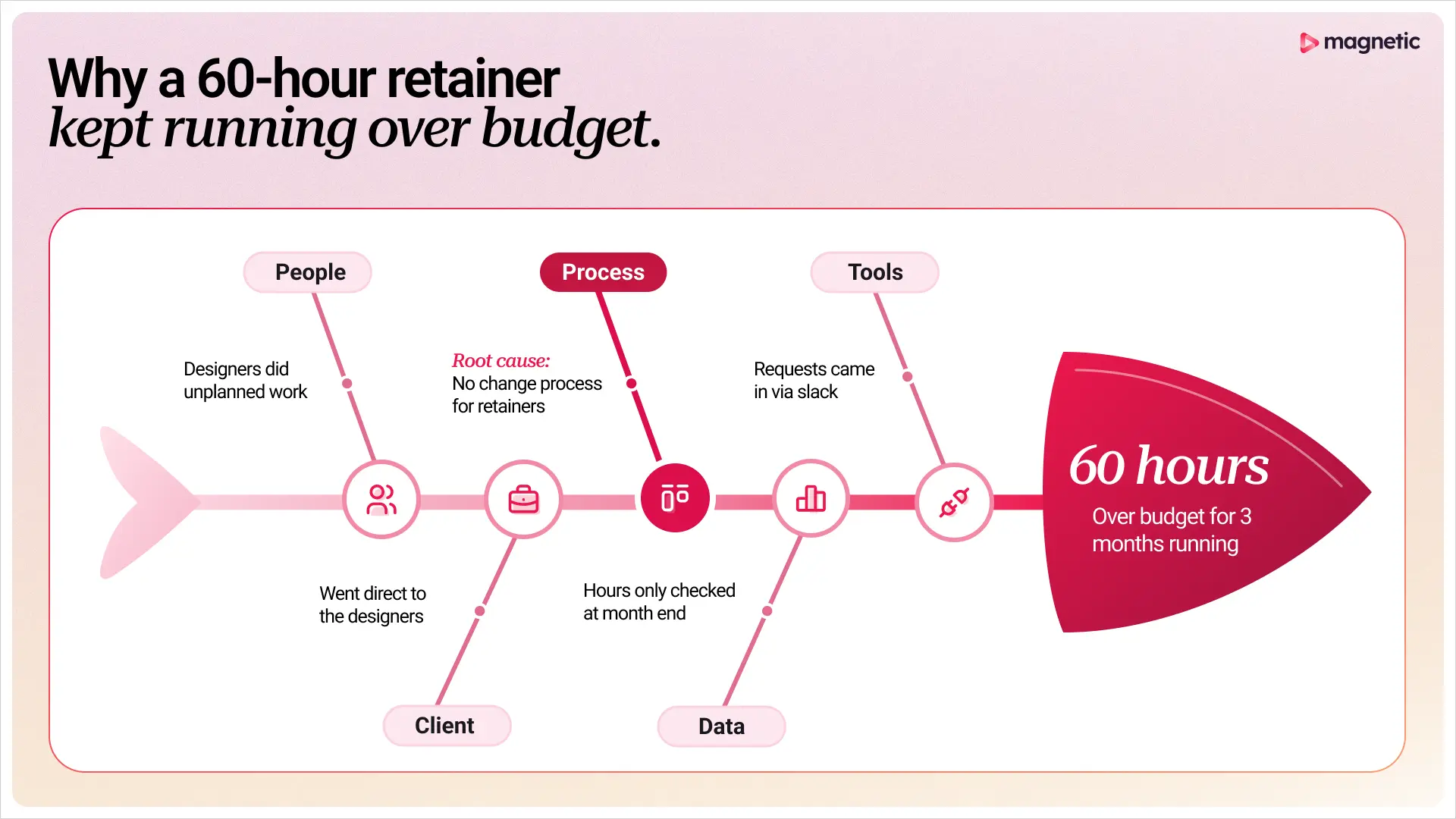
What changed:
You’ll notice “push back harder” isn’t on the list. The account manager wasn’t at fault; they just didn’t have a clear boundary to refer to. If out-of-scope requests are a pattern across your projects, our guide to spotting and stopping scope creep goes into more detail.
This is also why the data in step 2 matters so much. Dylan Kohlstadt, CEO of B2B agency Shift ONE, described what they needed before moving to Magnetic: "a platform that could integrate finance, time tracking, and project management so we could clearly see where we were overdelivering or underquoting" (Shift ONE case study). You can't trace an overrun back to its cause if you can't see where the hours went.
You don't need to adopt every technique. Most services firms get by with two or three.
A practical pairing: run a fishbone to get every possible cause on the wall, then Five Whys on the two or three that the evidence supports. Use Pareto once a quarter across all your overruns to see which root cause keeps turning up. Your reporting dashboards can show you which projects to look at.
Keep these records together. After six months, they show you which root causes keep returning, which is where your firm's real operational weaknesses are. Several of the patterns we see most often are in our guide to the mistakes that lead to project mismanagement.
Some fixes won't hold the first time, and some root causes sit one level deeper than you thought. That's not failure. It's what the review date is for.
Choose the last project that went over budget, or where the issue keeps coming up again and again. Book an hour with the people involved, bring the planned and actual numbers, and work through the six steps. End the session with one fix, one owner, and one review date. That's a working RCA.
If pulling those numbers together is the hardest part, it's worth seeing how Magnetic keeps project management, timesheets, budgets, and resourcing in one place. Start a free trial and run your next RCA on your own project data.

Root cause analysis finds why a problem happened. Corrective action is the change you make in response, from adjusting a project plan this week to changing a process for good. RCA is one step inside corrective action. Our guide to corrective action in project management covers the full process, including the triggers that tell you to act.
A post-mortem reviews one project and records lessons learned. An RCA looks for the cause behind a recurring problem and ends with a specific change, an owner, and a date. You can run an RCA as part of a post-mortem, but a post-mortem on its own rarely changes how the next project runs.
For most problems in a services firm, about two hours of people's time: an hour pulling data and an hour in a room working through causes. Problems spanning several teams or clients can take a few sessions over a week or two. If it's taking much longer, the data probably lives in too many places.
Everyone who was involved in the problem, across the stages it passed through. For a project overrun, that usually means whoever sold and scoped the work, the project manager, someone from the delivery team, and someone from finance. Keep it to five or six people, and have someone outside the project run the session if you can.
In project management, RCA also stands for root cause analysis. Project teams use it after a missed deadline, a budget overrun, or a quality problem, often alongside a RAID log so risks and issues found in one project feed into the next.
Jenna Green
Head of Growth
at Magnetic
Jenna Green leads marketing at Magnetic. She's worked across agencies, startups, and B2B SaaS, giving her first-hand experience of the operational challenges service firms face.


Magnetic is an all-in-one workflow management platform designed and built for professional services firms.